
When strawberries arrive on the table, it’s hard to resist their aroma and bright color. Yet, when it comes to preparing a dessert, the right question often remains the same: how much per person should be planned to keep a balanced portion, without shortage or excess? Between light desserts, generous tarts, and fruit salads, the right benchmark changes quickly. However, a few simple numbers are enough to aim accurately and combine pleasure, nutrition, and dietary balance.
The article in brief
Strawberries lend themselves to all desserts, provided the recommended portion is adjusted according to the context. Here are the most useful guidelines to serve just right, while keeping the pleasure intact.
- Simple dessert guideline: count 8 to 10 medium strawberries per person
- Portions according to usage: adapt between 50 and 150 grams depending on the recipe
- Benefits not to be overlooked: strawberries support health with few calories
- Useful daily habits: choosing, storing, and serving fresh fruit without waste
With a few concrete markers, the quantity per person becomes easy to adjust and the dessert gains in accuracy.
How many strawberries per person for a well-measured dessert?
For a simple dessert, the most practical reference remains 8 to 10 medium strawberries per person, or about 100 to 120 grams. This benchmark works well for a balanced portion, especially if the strawberries are served plain, with a bit of sugar, cream, or a splash of lemon.
At a summer reception, this base avoids complicated calculations. A group of four guests can therefore count on around 400 to 500 grams of fresh fruit, while a more generous serving will go up to 120 to 150 grams per person if the strawberries become the centerpiece of the dessert.
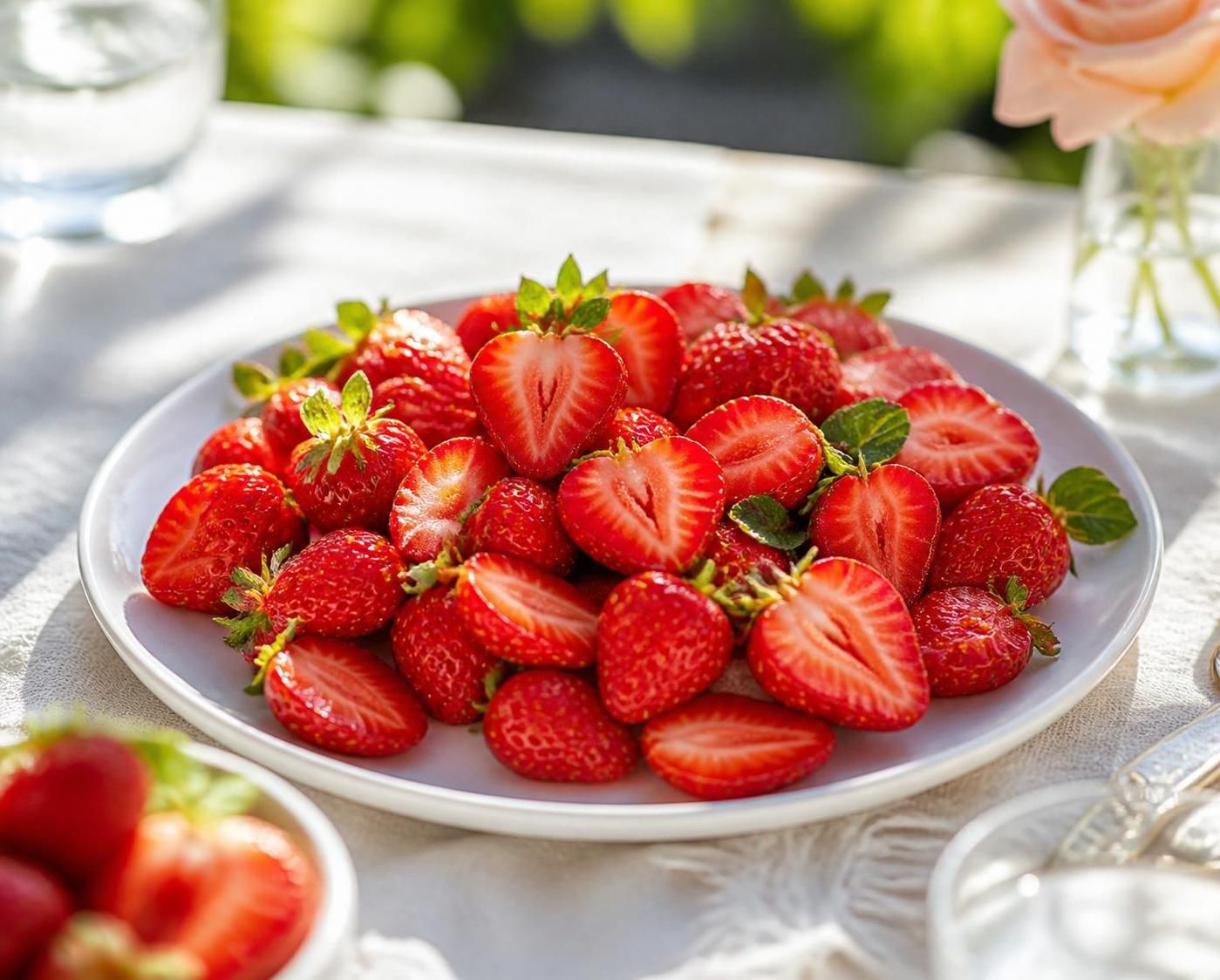
The right benchmark depending on the role of strawberries on the plate
It actually all depends on the role given to the fruit. If strawberries accompany a cream, panna cotta, or fruit salad, the quantity can drop to around 50 to 75 grams per person, or 5 to 7 medium-sized berries.
Conversely, when they become the star of the dessert, the recommended portion easily rises to 120 to 150 grams. This is the ideal amount for a summer snack, buffet, or meal where one aims to maintain good dietary balance without sacrificing indulgence.
Adjusting quantity per person according to the recipe
The best way to forecast well is to think by usage. A strawberry tart cannot be calculated like a verrine, and a smoothie does not require the same density as a plate of fresh fruit. This is where culinary logic meets nutrition: the same fruit can change role without changing quality.
In home cooking, this flexibility simplifies everything. A grandmother preparing a spring dessert won’t serve the same amount if the strawberries accompany a yogurt cake or if it’s a large bowl to share after the meal.
| Type of preparation | Recommended quantity per person | Practical guideline |
|---|---|---|
| Plain strawberries in dessert | 100 to 120 g | 8 to 10 medium strawberries |
| Fruit salad | 50 to 75 g | 5 to 7 strawberries |
| Strawberry tart or cake | 120 to 150 g | more generous portion |
| Verrine or cup with cream | 80 to 100 g | lighter dessert |
| Smoothie or coulis | about 150 g | fruity and thick texture |
For a standard 8-piece tart, it is often necessary to plan between 300 and 400 grams of strawberries, depending on their size and arrangement. This figure provides a reliable base to get good coverage without going overboard.
The size of the fruit really changes the game
Small strawberries take up less space but require more pieces, while large strawberries quickly fill the plate. An average fruit often weighs about 12 grams, which explains why 8 to 10 strawberries are sufficient in many cases.
For a refined preparation, it is better to choose regular and bright red fruits. The 2026 markets also highlight short supply chains more, which helps to find fresher, more fragrant fruits that are more stable when cut.
Why do strawberries naturally find their place in a balanced diet?
Beyond pleasure, strawberries have a rightful place in a health logic. They provide few calories, lots of water, and a good dose of vitamin C, making them a particularly interesting dessert for regular fruit consumption.
A 100-gram portion provides about 32 kcal and up to 58 mg of vitamin C, a very solid contribution to daily needs. For people monitoring their sugar intake, strawberries also remain a smart choice, especially if they replace richer desserts.
Studies on antioxidants also confirm their interest, notably thanks to anthocyanins responsible for their red color. To deepen this aspect, a detour to the total antioxidant capacity of fruits sheds light on their role in daily nutrition.
A simple fruit, but not trivial for everyday life
In a period where many seek to eat better without complicating meals, strawberries offer an ideal compromise. They easily integrate into an evening dessert, a snack, or a more balanced breakfast, as some signs around adapted breakfasts also show.
This simplicity probably explains their ongoing success. A fruit as accessible, as visual, and as adaptable naturally finds its place between pleasure and nutrition, without imposing rigid rules.
How to choose and store strawberries to keep all their flavor?
A good portion calculation is useless if the fruit loses its firmness before serving. It is better to choose well-colored, firm, and fragrant strawberries, with a clear smell and shiny surface. A strawberry that is too soft or dull will rarely give the same result on the plate.
Storage also plays a decisive role. Strawberries ideally should be kept cool, in a ventilated container, without prior washing to avoid excess moisture. If the basket is too full, some can be frozen after careful drying, to limit waste.
- Choose bright red and firm fruits
- Avoid washing them too early
- Store in the refrigerator in a ventilated container
- Reserve the best pieces for serving
This kind of vigilance changes everything at a buffet or picnic. Well-prepared fruit gives a fresher, cleaner, and more appetizing impression, even with a very simple recipe.
Service ideas that highlight strawberries without overloading the dessert
Strawberries shine especially when the presentation remains simple. In verrines, they benefit from being paired with a light fresh cheese, a lightly sweetened coulis, or some mint leaves. In a cup, their color is often enough to create the desired effect.
For a summer snack or an outdoor birthday, it is possible to offer fruit skewers, individual cups, or a large dish to share. The right amount per person then becomes easier to estimate because the dessert is no longer just a fruit but a coherent whole.
An impromptu cooking workshop with children illustrates this well: when strawberries are nicely cut and distributed in ramekins, the recommended portion is generally respected without frustration. The visual pleasure often helps to better dose.
How many strawberries to plan per person for dessert?
Most often, 8 to 10 medium strawberries are sufficient, or about 100 to 120 grams for a balanced portion.
How much is needed for a strawberry tart?
For a standard tart, you generally need to count between 300 and 400 grams of strawberries, depending on the size of the fruit and the number of slices.
Can the portion be reduced if other desserts are served?
Yes, in this case 50 to 75 grams per person may be enough, especially if the strawberries are only an accompaniment.
Are strawberries compatible with a light diet?
Yes, they are low in calories, rich in vitamin C, and beneficial for health, making them an excellent choice in a balanced diet.


