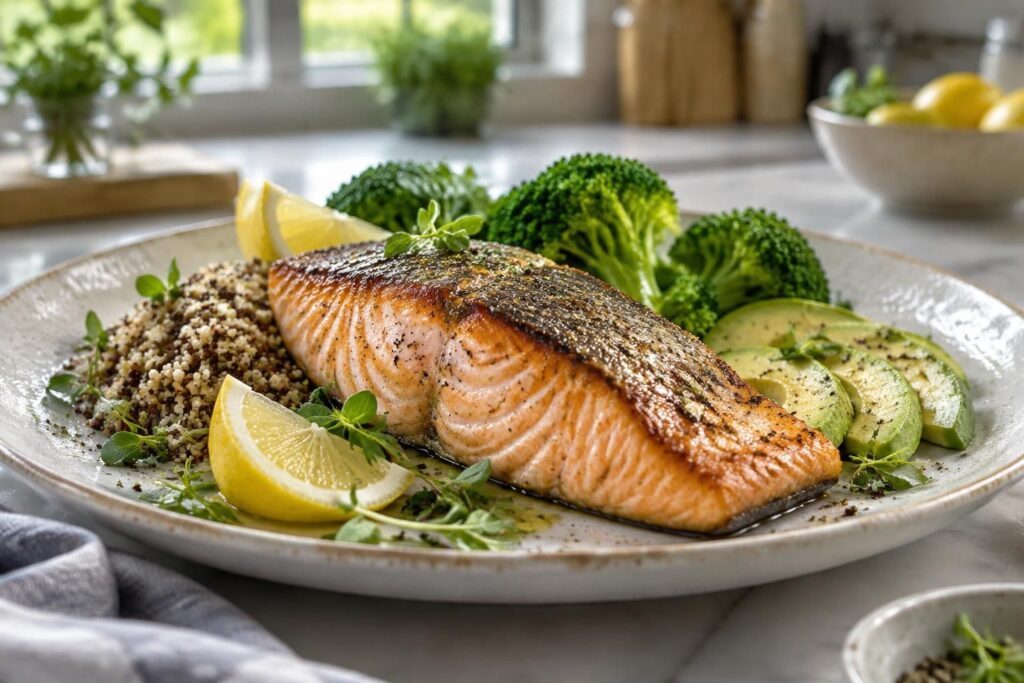
A salmon fillet generally provides around 200 kcal per 100 g, but its weight, composition, and cooking method cause the total to vary. Rich in proteins and omega-3, it can fit into a balanced meal without the need to count every bite: a few guidelines are enough to choose your portion and cook according to your desires.
Article in brief
Salmon combines proteins, beneficial fats, and generous flavor. Here are useful guidelines to estimate its calories and enjoy its benefits.
- Caloric benchmark: Count about 197 kcal per 100 g of raw salmon.
- Portion effect: A 150 g fillet provides nearly 296 kcal.
- Nutritional assets: Proteins and omega-3 contribute to daily dietary balance.
- Controlled cooking: Oven, steam, or grill without additions limit extra calories.
To remember: the fillet’s weight and the cooking ingredients change the meal’s nutritional balance.
Calories in a salmon fillet: portion guidelines
For a plain salmon fillet, a common estimate is about 197 kcal per 100 g, with nearly 21 g of proteins and 12 g of fats. Based on this, a 150 g portion provides about 296 kcal before any addition of oil, butter, or sauce.
Values differ, however, depending on the product and the database consulted. Information provided for some commercial fillets ranges from about 197 to 230 kcal per 100 g, while a wild salmon fillet listed at 106 kcal shows a particularly lean profile: species, farming, cutting, and labeling can explain part of the gap.
Caloric value of salmon according to weight?
Calculation helps visualize the energy supply of salmon, but it remains indicative: for a packaged product, the label is the best reference. For example, if Camille chooses a plain 150 g fillet showing 197 kcal per 100 g, her portion represents about 296 kcal and 32 g of proteins.
| Type or portion | Estimated calories | Estimated proteins | To remember |
|---|---|---|---|
| Plain salmon, 100 g | 197 kcal | 21.4 g | Average provided benchmark |
| Plain fillet, 120 g | About 236 kcal | About 25.7 g | Calculated on the average basis |
| Plain fillet, 150 g | About 296 kcal | About 32.1 g | Cooking can change the final weight |
| Oven-baked or grilled salmon, 100 g | 171 kcal | 24 g | Distinct reference value |
Raw and cooked salmon figures do not always compare directly: cooking causes water loss, and data may pertain to different cuts or methods. To track intake precisely, it is better to weigh the fish in the same state as indicated on the label or nutritional table.
Benefits of salmon: proteins, omega-3, and nutrients
Salmon proteins are called complete because they provide the amino acids necessary for the body. They participate notably in tissue renewal and muscle mass maintenance, and make the meal satisfying when combined with vegetables and a fiber source.
Salmon also contains omega-3 fatty acids, especially EPA and DHA, as well as B vitamins and vitamin D in varying amounts. These nutrients contribute to salmon’s nutritional interest; however, they do not turn a single food into a remedy. Salmon and health should be considered within the framework of a varied diet, adapted to each individual.
How to include a salmon portion in a balanced meal?
A portion of salmon can be accompanied by roasted or steamed vegetables and whole grain rice, potatoes, or lentils. This combination brings varied textures and complements the fish with fibers and carbohydrates, without imposing rigid rules on plate size.
Needs vary according to appetite, physical activity, and the rest of the meal. A smaller portion may suffice in a dish accompanied by other nourishing foods; a larger portion may be suitable after an active day. Balance is built over time, not in a single dinner.
Salmon cooking and calories: choosing a simple method
Salmon cooking and calories are linked mainly to added fats. In the oven, steam, or grill, the fish can cook without oil; a teaspoon of oil or a knob of butter still adds energy to the dish. Lemon, herbs, garlic, or spices give flavor without requiring a rich sauce.
Steaming provides a tender texture and allows cooking without added fat. In the oven, a fillet placed on baking paper with vegetables remains easy to prepare; on the grill, brief cooking helps preserve its tenderness. In all cases, avoid cooking until it becomes dry.
- To lighten the plate: cook the fish by steaming or baking without added fat.
- To enhance flavor: add lemon, dill, pepper, or paprika rather than a creamy sauce.
- To estimate calories: consider the fillet’s weight and the oil used.
- To vary meals: pair it with vegetables and a grain or legume.
Why do labels show different values?
Available data do not always match: a 120 g fillet indicated at 172 kcal does not correspond to the calculation obtained by applying the average value of 197 kcal per 100 g. This discrepancy reminds us that product sheets may concern recipes, weights, or different calculation methods; it is therefore preferable to check the packaging of the purchased product.
Another difference comes from preparation: a value for 100 g of raw fish does not necessarily describe 100 g after cooking. Water loss concentrates some nutrients by weight, while the addition of oil increases the dish’s energy content. The right reflex is to compare data established under the same conditions.
Frequently asked questions about salmon fillet calories
How many calories in a 150 g salmon fillet?
Based on an average of 197 kcal per 100 g, a 150 g fillet provides about 296 kcal before adding oil, butter, or sauce. The actual value depends on the product and its label.
Which salmon cooking method provides the least calories?
Steaming, baking, or grilling without added fat avoid additional calories linked to oil and butter. The fish still retains naturally present calories in its flesh.
Is salmon rich in proteins?
Yes. Provided data indicate about 20 to 21 g of protein per 100 g of plain salmon, with variations depending on the product.
Does salmon contain omega-3?
Yes, salmon provides omega-3s, including EPA and DHA. Their content varies according to species, farming, and cut.


