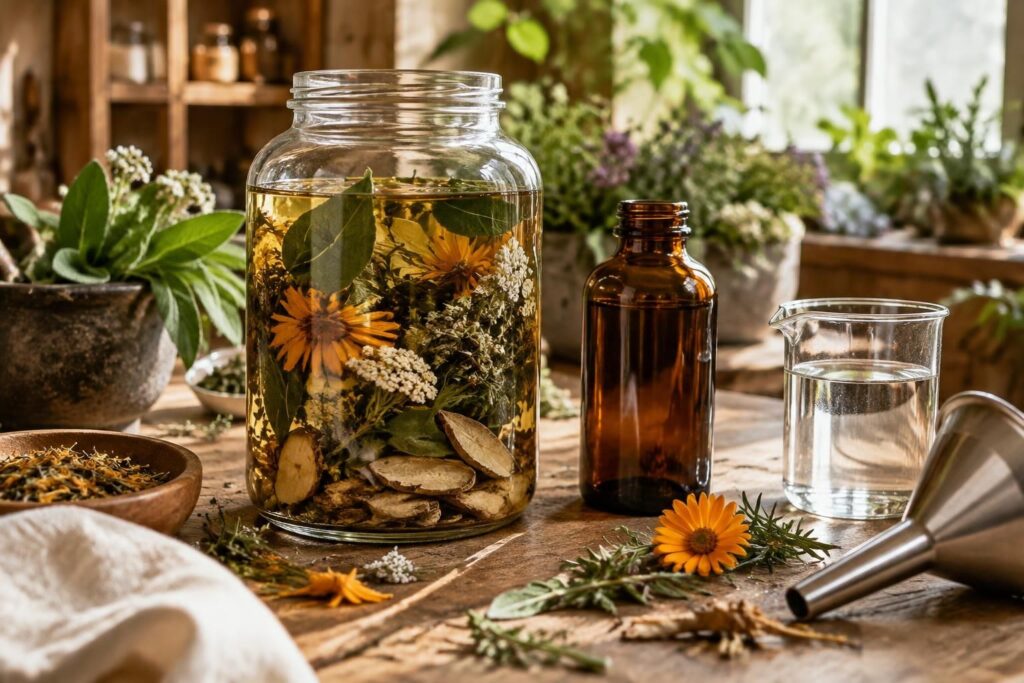
Combining alcohol and medicinal plants in homemade tincture requires more than just a jar and a few weeks of patience: the alcohol content, the state of the plant, and its identification influence the extraction of active ingredients. A careful preparation can be practical, but it is neither standardized nor without risk. Here are the essential guidelines to understand maceration and proceed with caution.
The article in brief
The mother tincture combines a plant with an alcoholic solvent to extract certain constituents. The choice of alcohol and the precautions taken are as important as the preparation method.
- Choose the right alcohol: favor a food-grade, non-denatured alcohol suitable for the plant.
- Identify the plant: verify its botanical name and avoid any uncertain picking.
- Master the maceration: cover the plant material and protect the jar from light.
- Ensure safety: take into account medications, contraindications, and risks related to alcohol.
To remember: a homemade preparation requires method and caution, and does not replace professional advice.
Mother tincture: how alcohol interacts with medicinal plants
A mother tincture, sometimes called an alcoholate, is an extract obtained by letting a plant macerate in a mixture of alcohol and water. Alcohol acts as a solvent: depending on its concentration, it can dissolve different constituents of the plant, while water also participates in the extraction of active ingredients.
This preparation differs from an infusion by its process and storage, but that does not mean it is automatically more effective or suitable for everyone. Its composition varies depending on the species, the harvested part, its fresh or dry state, and the proportions used.
An extraction that depends on the plant and the solvent
Tender leaves, roots, and seeds do not have the same structure. A fresh plant also contains water, which changes the final concentration of the mixture: an alcohol degree chosen without considering this humidity can yield a different result than expected.
Tinctures sold in herbal shops or pharmacies are prepared according to defined processes. At home, the preparation is not standardized and its dosage in active constituents cannot simply be deduced from its appearance or the maceration time.
To better understand the uses and limits of these preparations, also consult these guidelines on the combination of alcohol and plants.
Which alcohol to choose for a homemade plant tincture?
The starting point is an alcohol intended for consumption, unflavored and unsweetened, never a denatured or household alcohol. The appropriate degree depends on the plant and its moisture: there is no single concentration that fits all recipes.
A very strong alcohol should not be diluted randomly. Proportions must be calculated precisely, and a documented recipe or the advice of a competent professional is preferable. If the alcohol content or method are not clearly established, it is better to choose a commercial extract whose labeling specifies the composition.
| Element | To verify | Why it matters |
|---|---|---|
| Alcohol | Food-grade quality, indicated strength, absence of additives | The solvent influences extraction and safety of use. |
| Plant | Botanical name, part used, reliable origin | Species confusion can cause serious risk. |
| Jar | Clean glass, proper seal, readable label | Traceability helps control the preparation. |
| Storage | Closed bottle, protected from heat and light | Stable conditions limit alterations. |
Fresh or dry plant: do not apply a universal ratio
The amount of water contained in a fresh plant changes the plant-to-alcohol ratio. The proportions proposed in some recipes are therefore not interchangeable: a dosage intended for dried leaves does not mechanically apply to a fresh harvest.
Before any homemade preparation, you must know the species, the part used, and the reference recipe. Blackcurrant, St. John’s wort, or other plants sometimes presented in herbal shops can interact with treatments; their traditional reputation is not enough to guarantee their safety.
A concentrated tincture is not a more powerful infusion that can be taken without precaution: each plant sets its own limits.
Homemade preparation: the steps of cautious maceration
Picking is only conceivable if the plant is unequivocally identified and harvested in an unpolluted place. To start, a cultivated plant purchased from a reliable supplier reduces the risk of confusion; hands, utensils, and the jar must be clean and perfectly dry.
- Check the recipe: note the botanical name, the part used, fresh or dry state, and the recommended alcohol strength.
- Prepare the jar: use clean glass, then place the plant without compressing it excessively.
- Add the solvent: follow the planned proportions and ensure the plant material is submerged.
- Label immediately: write the plant name, date, alcohol used, and proportions.
- Monitor the maceration: keep the container closed, protected from light, according to the duration given by a reliable source.
- Filter and package: transfer into a clean bottle and keep the label with the product.
Duration alone is not a guarantee: extending the maceration does not necessarily make the extract better. Avoid adding water at the last moment to change the taste, as this alters the alcohol concentration and may compromise preservation.
Labeling and storage: keeping a reliable record
A complete label lets you know what the bottle contains, but also provides useful information to a pharmacist or doctor in case of questions. Indicate at minimum the botanical species, plant part, date, alcohol content, and proportions used.
Store the container closed, out of reach of children, away from heat and direct light. Alcohol may help preservation but does not guarantee unlimited shelf life: if there is an unusual smell, appearance, or closure, do not consume the preparation.
Dosage and precautions for alcoholic tinctures
There is no universal dosage suitable for all homemade tinctures. The concentration of artisanal products varies, and a number of drops sometimes mentioned in a recipe does not constitute a recommendation suited to each individual.
Alcohol is discouraged for certain people, especially children, during pregnancy and breastfeeding, as well as for those who must avoid any alcohol consumption. Plants may also interact with medications or be contraindicated depending on health status.
- Do not replace prescribed treatment with a homemade tincture.
- Ask a pharmacist or doctor for advice if under regular treatment.
- Avoid self-medication with a poorly identified plant or an unlabeled preparation.
- Keep bottles out of reach of children and do not confuse them with food products.
Additional information on precautions related to alcohol and medicinal plants can help raise the right questions but do not replace advice suited to your situation.
Caution is particularly important with St. John’s wort, known for possible interactions with several medications. In case of doubt, the safest option is not to use the preparation without first consulting.
Frequently asked questions about alcohol and plant tinctures
Can vodka be used for a mother tincture?
An unflavored vodka can be suitable for some recipes if its strength and composition are appropriate. The choice, however, depends on the plant and its fresh or dry state; follow a reliable recipe rather than a single rule.
How long should medicinal plants macerate?
The duration varies depending on the plant and the chosen method. Respect the indications from a documented source: extending maceration does not guarantee better extraction or a safer preparation.
Does a homemade tincture keep for several years?
Alcohol can promote preservation, but the duration depends on alcohol content, hygiene, and storage. A homemade preparation not being standardized, do not assume unlimited preservation.
Can you take a tincture at the same time as medication?
Interactions are possible, sometimes significant, depending on the plant and treatment. Consult a doctor or pharmacist before any use, especially with St. John’s wort.


