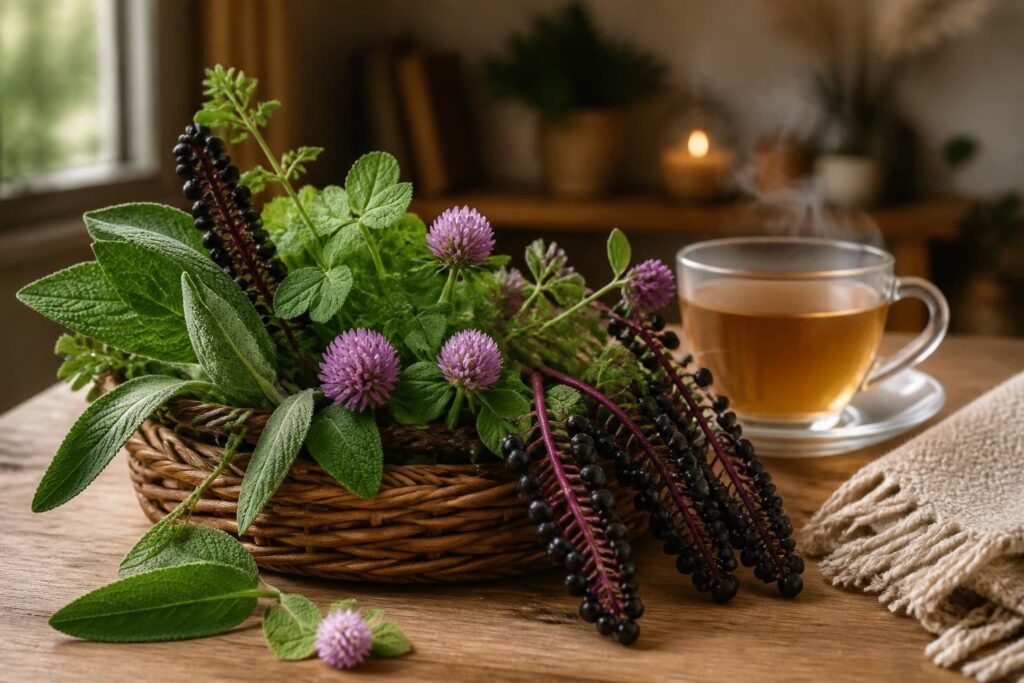
Hot flashes can turn an ordinary day into a real obstacle course, especially when menopause disrupts sleep, mood, and body confidence. Faced with these unpredictable temperature spikes, phytotherapy is attracting more and more attention, not as a miracle promise, but as a natural relief to be integrated methodically. Some medicinal plants act on sweating, others soothe the nervous system, and a few even play a supporting role for hormonal disorders. The challenge is to know which ones truly deserve their reputation.
Article in brief
Well-chosen plants can really reduce hot flashes linked to menopause. The key is to combine effectiveness, consistency, and caution to get the best out of natural remedies.
- Most useful plants: sage, lemon balm, vervain, and black cohosh
- Targeted effects: sweating, nervousness, sleep, and hormonal comfort
- Effective use: regular infusion requires several weeks
- Essential precautions: medical advice necessary depending on the individual
When used well, these plants can become true allies during menopause.
In a fictional wellness consulting office, a 49-year-old patient describes a very common scenario: nightly awakenings, a face that flushes during meetings, accumulating fatigue. The usual reflex is to look for a gentle solution, compatible with an active life. This is where phytotherapy comes into play, with a simple idea: help the body regain better balance, without forcing it, relying on repetitive and adapted gestures.
This topic deserves to be approached with nuance. Not all plants work the same way, and their interest depends as much on the dominant symptom as on the personal context. Some are useful when the heat is accompanied by heavy sweating, others when it adds up to stress or disrupted nights. The right choice therefore relies on a fine reading of needs, much like adjusting a recipe according to the ingredients already present.
Phytotherapy and hot flashes: understanding what plants can really do
Hot flashes often appear when the drop in estrogen disrupts the internal thermostat. The brain then misinterprets the body’s temperature, as if the regulatory system lost precision. Result: sudden heat, redness, sweating, sometimes palpitations. In this context, natural remedies aim either to gently compensate for hormonal imbalance or to calm secondary reactions, notably nervous agitation.
The logic is interesting because it allows distinguishing two major action families. On one side, plants rich in phytoestrogens, which provide indirect support to hormonal variations. On the other, those that act on stress, sleep, or sweating. This combined approach explains why a simple infusion can sometimes change the game after a few weeks, especially when integrated into a regular routine.
To go further with natural wellness approaches, a detour through naturopathy advice applied daily can usefully complement the reflection. The idea is not to change everything, but to adjust a few key levers with coherence.
Sage, lemon balm, and black cohosh: the most frequently mentioned plants
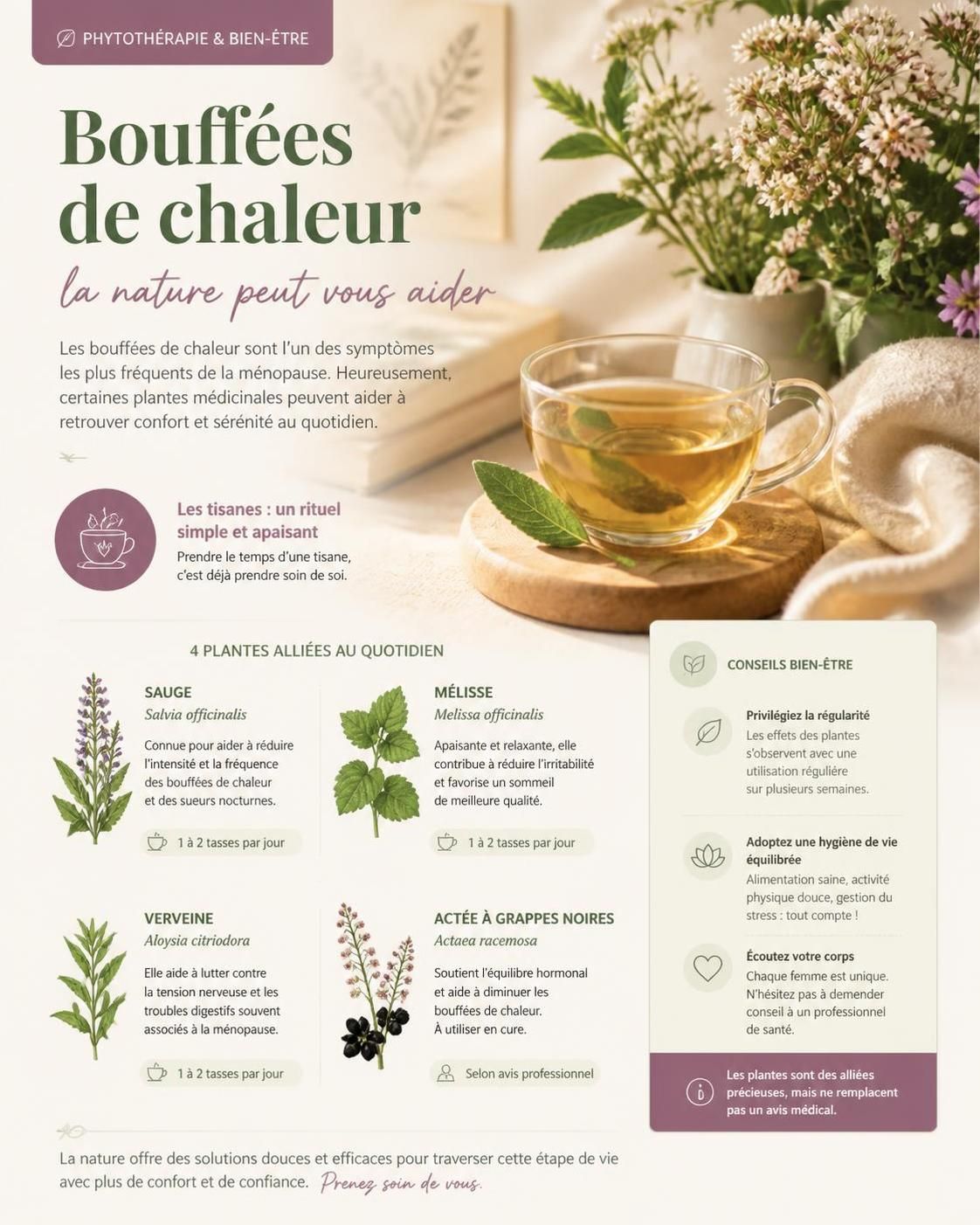
Sage is often cited front and center, as it helps reduce sweating and can lessen the frequency of hot flashes. In practice, it is particularly useful early in the day when symptoms are most bothersome. Lemon balm, on the other hand, responds more to episodes where heat is accompanied by inner tension, as if the body struggles to cool down.
Black cohosh holds a special place. It is often used in situations where hormonal fluctuations are more noticeable, with a sought-after effect on overall comfort, sleep, and sometimes mood. Its use, however, requires a stricter framework as it is not suitable for all profiles. This precisely distinguishes a simple plant from a truly well-thought-out strategy.
An anecdote often comes up among women testing these solutions: initial improvements rarely appear after the first cup. It generally takes a few weeks, much like a garden needing time to come back to life after winter. Consistency counts as much as the chosen plant.
Which medicinal plants to choose according to menopausal symptoms?
When symptoms overlap, it’s better to think in terms of objectives. One woman may want to reduce sweating, another to regain easier falling asleep, a third simply to get through the day without enduring this unpredictable burning sensation. The choice of medicinal plants then becomes clearer, almost like sorting by priority.
A practical reading helps a lot. Sage mainly acts on sweating, lemon balm on stress, vervain on evening relaxation, yarrow on digestive discomfort sometimes accompanying the period, and black cohosh on the overall hormonal profile. This diversity is a strength, provided not everything is mixed without strategy.
| Plant | Recommended time | Main effect | Usage guideline |
|---|---|---|---|
| Common sage | Morning or early afternoon | Reduces sweating and hot flashes | 1 to 3 cups per day, in short courses |
| Lemon balm | End of the day | Calms nervousness and night sweats | 2 to 3 cups per day |
| Vervain | Evening | Promotes relaxation and sleep | 1 to 2 cups per day |
| Yarrow | During the day | Supports digestive comfort | 1 to 2 cups per day |
| Black cohosh | Depending on medical supervision | Helps reduce hormonal symptoms | Monitored dosage, limited duration |
This table illustrates an essential rule: the right natural remedy isn’t necessarily the most known one, but the one that matches the time of day and the dominant symptom. For some supplements, a balanced diet also matters, especially when exploring plants rich in interesting compounds, as certain files on African foods and their benefits remind us.
Preparing an effective infusion without complicating daily life
A good infusion does not require a complex ritual. Hot water, a temperature close to 90 °C, an infusion time of 5 to 10 minutes, and quality plants are often enough to build a useful habit. With sage, it is preferable to stick to limited courses; with lemon balm or vervain, the intake can more easily be integrated in the evening as a signal sent to the body to slow down.
One detail often changes everything: consistency. People hoping for an immediate effect sometimes miss the essential point. In feedback, improvement becomes clearer after two to three weeks, then stabilizes more between four and eight weeks. The repeated gesture counts as much as the plant itself.
This logic echoes an idea often heard among those who include herbal teas in their routine: drinking a warm preparation is not just about “treating” a symptom, it also establishes a pause. And in a period where the body seems unpredictable, regaining this simple marker already has precious value.
What precautions to respect with plants against hot flashes?
Caution is an integral part of phytotherapy. Some active plants are not suitable for all profiles, especially in cases of hormone-dependent cancer history, ongoing hormonal treatment, or fragile liver condition. The idea is not to alarm but to remind that intelligent use requires a minimum of verification.
Sage and black cohosh, for example, require close attention. They can be useful in certain situations, but their place must be discussed with a healthcare professional. This point becomes even more important if other treatments are already underway. For those who like to combine approaches, resources on natural support for certain female disorders clearly show that a strategy can be personalized without being improvised.
The right reflex consists of observing, noting, and adjusting. When an herbal tea does not suit, the body often signals it: discomfort, unusual fatigue, disturbed digestion, or lack of effect. It’s better then to reassess the choice rather than multiply plants at random. It is often in simplicity that the relief becomes most lasting.
Situations where medical advice becomes essential
Medical advice is mandatory before any prolonged course if a woman has a history of breast cancer or hormone-dependent disease, is undergoing hormone replacement therapy, or if symptoms suddenly intensify. Even though phytotherapy fits a gentle logic, it remains active. This clarification prevents many self-medication errors.
Vigilance is also necessary in cases of pregnancy, breastfeeding, epilepsy, or liver fragility, depending on the plants considered. When in doubt, a healthcare professional can help decide without dramatizing. And it is often this reassuring framework that allows one to enjoy the benefits without getting lost in approximations.
A key point stands out here: plants help better when integrated into a global vision, not when used as a shortcut. Phytotherapy gains effectiveness when it accompanies a real listening to the body.
Combining plants with a lifestyle that truly soothes
Plants work better when they are not alone. Gentle physical activity, a more stable diet, and better stress management often strengthen their impact. This does not mean changing everything at once. A daily walk, some slow breathing, or a lighter dinner can already make a noticeable difference.
This global approach recalls a very concrete idea: during menopause, the body is not an adversary but a partner to be tamed differently. Some women notice that triggers are personal. For one, it will be alcohol; for another, a dish too spicy; for a third, lack of sleep. Observing these signals is how the strategy becomes effective.
Everyday gestures therefore play a decisive role. A wellness-inspired routine, close to what is found in some content on plants and natural health traditions, can offer complementary pathways. The essential remains to keep a realistic, progressive, and comfortable approach.
- Limit triggers: alcohol, overly spicy dishes, excess coffee
- Regulate rhythm: stable sleep, breaks, slow breathing
- Move without forcing: walking, gentle yoga, daily mobility
- Test methodically: one plant at a time, over several weeks
This list shows that better comfort does not depend on a single product but on a set of coherent small adjustments. It is often this sum of details that ends up soothing overly hot evenings and too-short nights.
Can sage be taken every day?
It can be used in short courses and at recommended doses, but continuous use must be supervised. One should also avoid combining it without medical advice with other sources of phytoestrogens.
How long does it take to feel an improvement?
Effects often appear after two to three weeks, with clearer benefits between four and eight weeks when intake is regular.
Can plants be combined with hormone therapy?
Some plants like lemon balm or vervain can be compatible, but sage and black cohosh require medical advice before combination.
Does phytotherapy replace prescribed treatments?
It can provide interesting support but does not systematically replace medical treatment. The choice depends on the profile, history, and intensity of symptoms.


