
The same common sense applies to sleep: when nights become very fragmented, a relaxation ritual can support falling asleep. Some people then associate self-hypnosis with a sleep technique inspired by deep rest to prepare the body to let go.
Underlying all this, one principle remains constant: it’s better to have a short, simple, repeated practice than an ambitious session abandoned after two days.
How long does it take to feel the effects?
A few minutes may already be enough to feel a release, but the clearest effects on calm, concentration, and well-being build with regular practice.
Can self-hypnosis help to sleep better?
Yes, especially when it relies on breathing, body scan, or the image of a resource place. These exercises promote relaxation and facilitate falling asleep.
Do you have to be very focused to start?
No, the method relies precisely on a progressive training. Even with scattered thoughts, it is possible to gently return to the breath or a soothing image.
What is the difference with guided hypnosis?
In guided hypnosis, a practitioner accompanies the session. In self-hypnosis, the person alone uses simple anchors such as breathing, visualization, or a positive suggestion.
Self-hypnosis is attracting more and more people who are looking for a simple exercise to regain calm without disrupting their daily life. In a few minutes, this practice helps to slow down the mind, release tension, and bring focus back to the center, like a beacon that guides attention when everything seems to be going in all directions. That’s precisely the point: no experience or equipment is needed, just a quiet moment and a clear method.
The article in brief
Self-hypnosis offers an effective break to soothe the mind and regain better grounding in everyday life. A few simple gestures are enough to establish a state of relaxation useful for stress management and focus.
- Easy access to calm: a few minutes are enough to release pressure
- Concrete exercises: breathing, fixed point, body scan, resource place
- Progressive effect: regularity strengthens concentration and well-being
- Flexible practice: everyone can adapt the session to their own pace
With a simple and regular exercise, self-hypnosis becomes a discreet but powerful support to breathe better and refocus.
When the brain goes in circles, it resembles a window with too many tabs open. Self-hypnosis precisely proposes to close those that are tiring, without forcing, relying on breathing, bodily sensation, or a soothing image. This approach appeals as much to overworked people as to those who simply want to regain a better quality of presence, much like tidying up a cluttered desk. In a context where digital solicitations remain omnipresent, this type of break takes on a very concrete value for well-being.
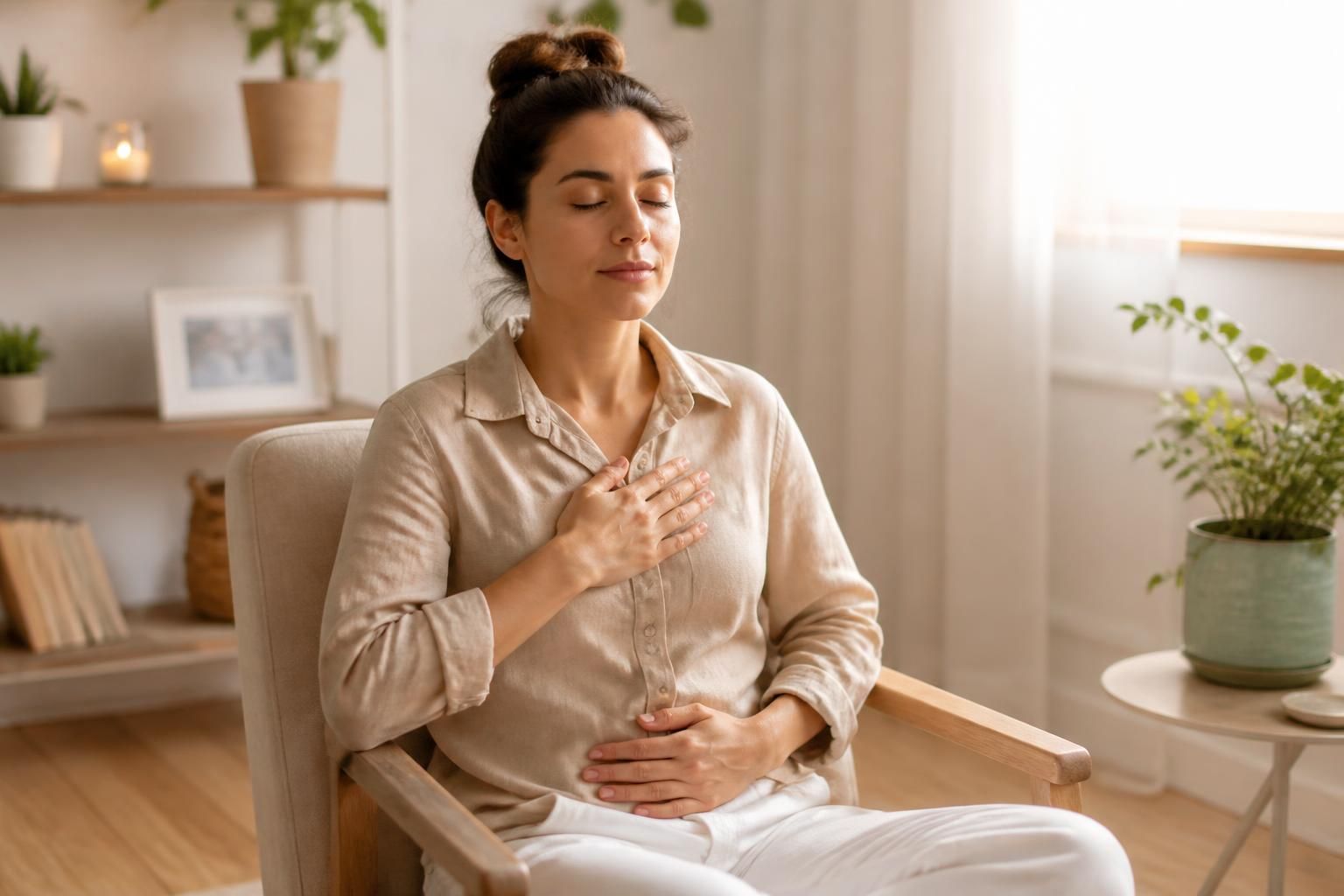
Why self-hypnosis helps to regain calm and concentration
The main interest of self-hypnosis is its flexibility. It can be used to soothe a rise in stress before a meeting, prepare for sleep, or rekindle attention after a busy day. As in meditation, it is not about fighting thoughts, but gently shifting the spotlight to a more stable point.
Some also use it as a transition between two activities. For example, Léa, 34, a remote-working executive, integrated two minutes of conscious breathing between her calls; this small ritual helped her reduce feelings of distraction and regain better focus. The logic is simple: the more the mind learns to return to a clear anchor, the more it gains stability.
Sources such as the WHO or INSERM regularly remind the importance of relaxation practices in preventing chronic stress. Self-hypnosis does not replace medical care, but it fits into a useful lifestyle hygiene, just like a daily walk or more regular meals.
The most sought effects in daily life
The practice does not act only in the moment. With a bit of regularity, it can also improve sleep quality, support working memory, and make days less hectic. It’s a bit like lubricating the gears of an overworked mechanism: everything doesn’t become perfect, but everything flows better.
- Reduction of mental tension: attention leaves the flow of automatic thoughts
- Return to the body: sensations serve as a more stable support point
- Strengthening calm: the nervous system gradually decreases in intensity
- Better concentration: the mind learns to stay focused on one task
This progression explains why many beginners already feel a relief from the first sessions, even short ones. The key is not performance, but quiet repetition.
Which simple exercise to practice to enter self-hypnosis
Among the most accessible exercises, conscious breathing often remains the best starting point. Sitting comfortably, simply inhale through the nose then exhale more slowly, as if each breath laid a bit more weight on the ground. This mechanics is simple but incredibly effective: it gives the mind a clear task and prevents it from scattering.
Another very popular entry is to fixate a still point for a few moments. When the eyes tire slightly, attention naturally relaxes, which fosters a state close to meditation. For some, this simple exercise creates an almost immediate sensation of calm; for others, it takes two or three tries for the body to understand the signal.
A guided 5-minute example to try at home
This short format suits busy schedules well. It can be practiced before working, after an intense day, or just before bedtime if the goal is to prepare for a more peaceful sleep.
- Close your eyes and take three slow breaths.
- Voluntarily release the shoulders and jaw.
- Count down from 10 to 1 imagining a peaceful descent.
- Visualize a reassuring place, real or imaginary.
- End by repeating a short, positive phrase.
This sequence acts as a small staircase toward relaxation. The countdown creates a mental transition, while the image of the resource place provides an immediately available inner refuge.
Breathing, body scan, and resource place: three techniques that change everything
Breathing is the simplest common thread, but it’s not the only option. The body scan, for example, invites mentally traveling through each area of the body to spot subtle tensions that accumulate silently. It’s often very revealing at the end of the day, when shoulders are tight and the neck demands a real break.
The resource place works like an inner room open on demand. A beach, a forest, a peaceful bedroom, or even a childhood memory can become this anchor point. The more detailed it is, the more the brain accepts settling there, like a reader entering a well-written novel.
| Technique | Ideal moment | Desired effect |
|---|---|---|
| Conscious breathing | Before a task or a meeting | Quickly soothe the mind |
| Body scan | In the evening or after exertion | Spot and release tensions |
| Resource place | When stress rises | Strengthen the feeling of security |
| Fixed point | At the start of a session | Establish a calm concentration |
For some people, this combination resembles a very concrete, almost tactile form of meditation. It requires no special talent, just the desire to return to oneself regularly.
How to choose the most suitable technique
The right choice mainly depends on the current need. When the mind is agitated, breathing and countdown help to calm down quickly. When the body is heavy or tense, the body scan often becomes more relevant. And when the goal is to reassure oneself before a demanding day, the resource place offers very gentle psychological support.
In all cases, the idea is not to multiply methods but to adopt just one at first. This is often how a lasting habit is born, comparable to a small morning or evening ritual.
Tips to establish a regular practice without discouragement
Regularity matters more than duration. A few minutes a day are enough to anchor the reflex, especially if the session takes place in a quiet location and at roughly the same time. The important thing is to keep a light approach: self-hypnosis is not a test, it’s a recovery space.
A beginner can also associate the session with an already known gesture, such as preparing tea, turning off the computer, or closing the shutters. This type of association helps the brain recognize the pause signal. Many people find a concrete support for stress management without disrupting their schedule.
If more advanced support becomes necessary, a practitioner can guide the first sessions. Autonomous practice remains, however, a solid base, simple to integrate, and often sufficient to feel a better quality of presence daily. It is precisely this simplicity that makes it sustainable.
Common mistakes to avoid to maintain good concentration
The most common trap is wanting to “succeed” too quickly. In self-hypnosis, trying to control everything often produces the opposite effect: attention tightens and relaxation recedes. It’s better to let sensations come as you let muddy water become clear again without stirring the bottom.
Another frequent mistake: practicing only when everything goes wrong. Even if a one-off session can help, the clearest benefits appear when practice becomes a regular, brief but stable appointment. A bit like hiking, endurance is built step by step.
Finally, it is useful to stay attentive to what the body tells you. If fatigue is significant or discomfort persists, self-hypnosis can supplement other health solutions, but must not replace them.
In some situations of psychological suffering, intense or lasting symptoms must be evaluated by a professional, especially if accompanied by anxiety or marked withdrawal. On this subject, additional insight on the signs and causes of borderline disorder can help better distinguish a simple passing tension from a deeper difficulty.
The same common sense applies to sleep: when nights become very fragmented, a relaxation ritual can support falling asleep. Some people then associate self-hypnosis with a sleep technique inspired by deep rest to prepare the body to let go.
Underlying all this, one principle remains constant: it’s better to have a short, simple, repeated practice than an ambitious session abandoned after two days.
How long does it take to feel the effects?
A few minutes may already be enough to feel a release, but the clearest effects on calm, concentration, and well-being build with regular practice.
Can self-hypnosis help to sleep better?
Yes, especially when it relies on breathing, body scan, or the image of a resource place. These exercises promote relaxation and facilitate falling asleep.
Do you have to be very focused to start?
No, the method relies precisely on a progressive training. Even with scattered thoughts, it is possible to gently return to the breath or a soothing image.
What is the difference with guided hypnosis?
In guided hypnosis, a practitioner accompanies the session. In self-hypnosis, the person alone uses simple anchors such as breathing, visualization, or a positive suggestion.


