
A small white nail spot often intrigues more than it worries. Yet, behind this subtle sign, leuconychia can tell a simple story of nail trauma… or draw attention to broader white nail spot causes, such as a nail infection, zinc deficiency, or a general health disorder. The most important thing remains to know how to read white nail symptoms without panicking or trivializing when concern is needed.
The article in brief
White spots on the nails are most often benign, but some forms deserve real attention. Recognizing signs, understanding causes, and identifying situations that justify medical advice helps avoid many unnecessary worries.
- The most common: a micro-impact damages the nail matrix
- Real causes: fungal infection, deficiency, allergy, or general disease
- Signs to watch for: multiple affected nails, thickening, detachment
- The right reflex: observe changes and consult if needed
Better reading of your nails means spotting early what is harmless and what requires assessment.
In real life, this small white spot often appears when it is least expected: after a manicure done a little too vigorously, a finger caught in a door, or simply a few weeks after a forgotten impact. That’s where confusion begins. Many immediately think of a calcium deficiency, whereas most abnormal nail signs of this type rather stem from a minor nail trauma unnoticed at the time. Like a message written in invisible ink, the nail takes time to reveal what it has undergone.
But not all white nail spot causes are alike. Some are common and disappear with growth; others indicate nail fragility, a fungal infection, a deficient condition, or more rarely, a liver or kidney disorder. The right reflex is therefore not to scrutinize every imperfection fearfully, but to look at the whole picture: how many nails are affected, what shapes the marks take, and what other white nail symptoms accompany the change? This overall reading makes all the difference.
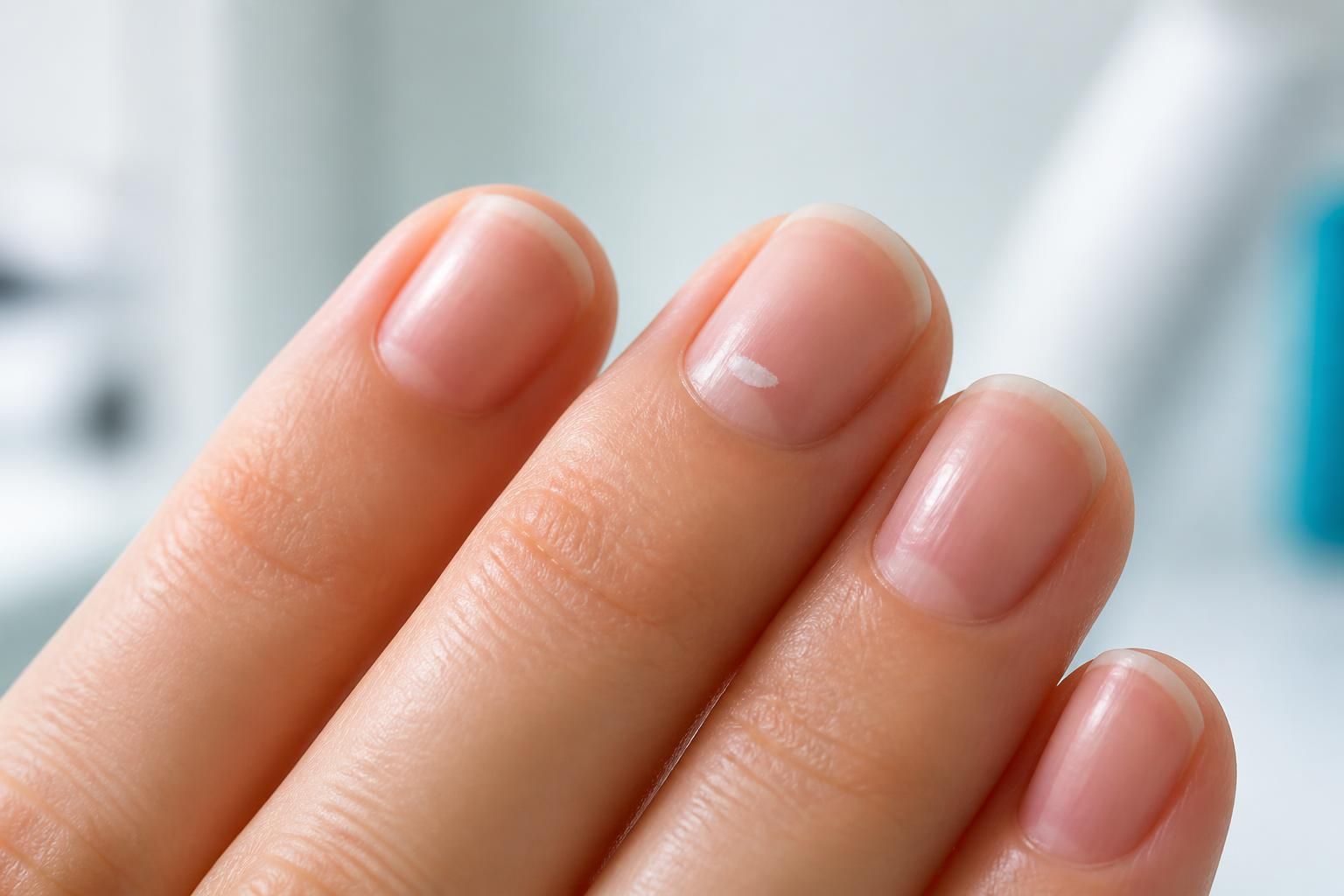
Leuconychia: when the white nail spot is simply a mechanical signal
The term leuconychia simply refers to a white discoloration of the nail, whether punctate, linear, or more extensive. The most common form remains the small isolated spot, the one seen on a single nail and signaling nothing serious. In most cases, it comes from a micro-trauma to the matrix, the hidden area at the base of the nail where cells are produced.
In other words, the mark doesn’t appear because the nail “lacks white,” but because it was produced slightly differently after a shock. A sudden gesture, bitten nails, an overly aggressive manicure sander: the mark can then slowly move towards the tip over several weeks. This time lag explains why so many people do not connect it with the triggering event.
A reader recently said she discovered several small white spots after an intense period of DIY work. Nothing alarming: the picture suggested a simple repetitive accident, exactly the kind of situation where nail care primarily aims to protect and allow regrowth. When the sign remains isolated, without pain or deformation, observation is often enough.
The best clue remains simple: if the nail whitens in small touches, without thickening or detachment, it is most often a story of impact, not a hidden disease. The nail speaks, but sometimes in a very ordinary way.
Forms that deserve more attention
Small round spots do not tell the same story as white bands or an almost entirely pale nail. Horizontal lines, for example, can indicate an episode of significant physical stress, a recent illness, or, more rarely, poisoning. When several nails change together, the message is different.
Another better-known case is that of the almost entirely white nail, sometimes associated with Terry’s nails. Here, the signal may point to chronic liver disease or, less commonly, kidney disease, and warrants a quick consultation. The form of the mark matters as much as its presence.
To keep a clear reading, this table helps sort things out without dramatizing:
| Observed aspect | Most probable cause | Recommended reaction |
|---|---|---|
| One or two isolated spots | Single trauma | Simple monitoring |
| Multiple affected nails | Deficiency or general context | Possible medical check-up |
| Yellow-white, thick nail | Fungal infection | Dermatology consultation |
| Almost entirely white nail | Liver or kidneys | Rapid medical advice |
| Horizontal white bands | Stress or recent illness | Monitoring and clinical context |
This visual reading avoids a classic trap: wanting to explain everything by a single cause. Nails are rarely as simple as preconceived ideas.
White nail spot causes: from subtle trauma to nail infection
When marks persist, often recur, or affect multiple fingers, the range of hypotheses must be expanded. Initial explanations remain often mechanical, but other causes exist: allergy to nail polish, reaction to certain household products, fungal infection, nutritional deficiency, or skin disease like vitiligo. Nails then act as a display board, sometimes very sensitive, reflecting body imbalances.
Among frequent causes, nail infection of the fungal type occupies an important place. The nail then becomes yellow, white, or brown, thickens, becomes brittle, and may detach from the nail bed, especially on the feet. It is no longer a simple spot: the structure itself changes.
Allergies produce another profile. Polish, removers, gels, or cleaning products can irritate the area and disrupt nail growth. In this case, simple measures often help: choosing gentler formulas, wearing gloves for cleaning, and limiting repeated aggressions.
Hormonal changes, certain antibiotics, chemotherapy, or some skin diseases can also change the color. Here, the spot is only one element among others, and the whole context guides what comes next.
Nutritional deficiencies not to confuse with a myth
The reflex “it’s surely calcium” often comes up, but it oversimplifies the subject. A true zinc deficiency can, however, promote the appearance of white spots on several nails, sometimes with hair loss, slow healing, or decreased immune defenses. Iron also plays a role: when lacking, nails can pale, become concave, and accompany fatigue or breathlessness.
You must therefore consider the overall context. In certain situations, a too restrictive diet, bariatric surgery, or prolonged imbalance eventually leaves a visible trace on keratinized tissues. It is moreover this subtle link between nutrition, sleep, and energy that often surprises: correcting a deficiency can improve both nails and daily vitality.
A useful point of vigilance: when white marks are multiple and other signs occur, a blood test becomes more relevant than a simple strengthening nail polish. Nails do not replace blood tests, but they can give an alert.
For the clearest situations, this list helps better orient oneself:
- A single white spot after a shock or intense manicure
- Multiple affected nails with fatigue or paleness
- Thickened or brittle nail suggesting a fungal infection
- Almost total whitening pointing to liver or kidney trouble
- Horizontal white bands after stress or illness episode
This grid does not replace medical advice, but it avoids putting all cases in the same basket. And that is already real progress.
When to worry about nails: white nail symptoms that require consultation
The right question is not “Is there a white spot?” but “How is it evolving?” An isolated, stable, and old mark does not have the same weight as a progressive, multiple change or one associated with other abnormalities. It is precisely here that knowing when to worry about nails becomes useful.
Certain signals require seeking advice: multiple fingers or toes affected suddenly, discoloration progressing without known trauma, nail thickening, splitting, detachment, or general symptoms such as marked fatigue, jaundice, edema, or weight loss. In these cases, the nail is no longer a cosmetic detail but part of a larger medical puzzle.
The most urgent situations are rare but do exist. An almost entirely white nail can suggest liver or kidney damage. Horizontal white lines on several nails, especially after a severe episode or toxic exposure, also justify a rapid assessment. It is better not to wait for regrowth to make the problem disappear because the cause may persist.
In less alarming cases, a dermatologist or general practitioner can distinguish a simple accident from a disorder needing assessment. Diagnosis relies on nail examination, recent history, and, if necessary, targeted analyses.
Nail care: useful steps to protect, strengthen, and limit recurrences
Prevention often relies on very concrete habits. Limiting shocks, avoiding picking at cuticles, spacing aggressive manicures, and choosing less irritating products already helps a lot. Nail care is not a miracle promise but a regular protection strategy, somewhat like maintaining a hike rather than fixing a sprain.
When a nutritional cause is confirmed, management becomes more specific. Biotin is sometimes offered for a few months to improve resistance, while zinc or iron supplementation is only discussed after biological confirmation. Adding sufficient proteins remains important, as keratin making up the nail depends directly on it.
An interesting detail concerns sleep: zinc and iron deficiencies are not limited to nails. They can also disrupt falling asleep, recovery, and rest quality, which explains why correcting a deficiency sometimes changes much more than the hands’ appearance. The body functions as a coherent whole, not as a series of separate compartments.
To keep nails stronger daily, a few simple steps make the difference:
- Moisturize nails and cuticles regularly
- Wear gloves for cleaning and chemicals
- Avoid overly abrasive files and repeated sanding
- Do not tear small skin around the nail
- Consult if marks become frequent or multiple
When the routine is gentle, the nail often recovers better. It is often in these small daily steps that the difference is made.
Useful answers about leuconychia and white spots
Is a small white spot on a single nail serious?
Most often, no. An isolated spot frequently corresponds to a micro-trauma and disappears with nail regrowth.
Can calcium deficiency explain a white nail spot?
This link is mainly a myth. The most common causes are trauma, fungal infection, zinc deficiency, or other factors.
Which white nail symptoms require consultation?
Advice should be sought if multiple nails are affected, if the nail thickens, detaches, changes shape, or if coloring is accompanied by fatigue, jaundice, or weight loss.
Can a nail infection start with a simple white spot?
Yes, especially in the case of a fungal infection. The nail often then becomes thicker, brittle, discolored, and sometimes detached.
Is nail care enough to make marks disappear?
They mainly help prevent recurrences and protect the nail. If the cause is a deficiency, infection, or disease, appropriate treatment remains necessary.


