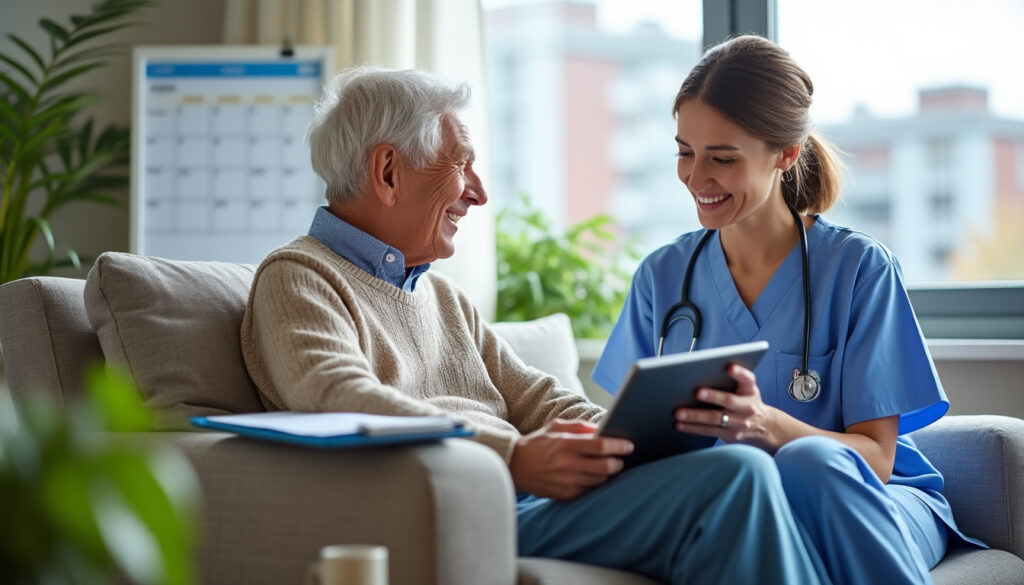
In an increasingly complex medical context, the transition from hospital to home represents a crucial step, especially for vulnerable patients. The Transition Care Program establishes itself as an essential system to ensure an effective continuity of care, by reducing the risks of readmissions and improving quality of life. This coordinated approach relies on rigorous planning, smooth communication between professionals, and strong involvement of the patient and their family. Together, these elements make the program a major lever to guarantee the safety and well-being of people in medical transition.
🕒 The article in brief
The transition care program facilitates the crucial passage between hospitalization and home, reducing complications. Care coordination, personalized management, and the use of emerging technologies promote optimal post-hospital follow-up.
- ✅ Central role of the program: Ensure smooth coordination to preserve continuity of care
- ✅ Adapted models: BOOST, CTI, and TCM, each promoting secure transitions
- ✅ Family involvement: Support patients and caregivers through education and communication
- ✅ Technological innovation: Digital tools to optimize personalized management and follow-up
📌 An integrated and concerted care approach to transform the post-hospital phase into a successful care pathway.
The foundations of the Transition Care Program and its challenges in care coordination
In the current healthcare landscape, the transition program stands out as an essential response to the challenges posed by the move from a hospital setting to a more familiar environment, such as home. This delicate moment, often a source of uncertainty, notably exposes fragile patients to an increased risk of complications or loss of follow-up. For these people, often elderly or suffering from chronic diseases, patient management during this period must be rigorous.
The transition care program relies on a multidisciplinary approach, where doctors, nurses, pharmacists, and family caregivers work together in optimal coordination. Interprofessional communication then becomes the foundation on which this coordination is built, ensuring a clear and complete transfer of information. For example, medication reconciliation, a critical step, avoids frequent errors during the change of therapeutic environment.
Anticipated planning of hospital discharge is also essential. It includes organizing medical appointments, preparing the home environment, and personalized support. In 2025, a study demonstrated that this well-orchestrated approach can reduce readmissions by up to 22%, thus highlighting the importance of a structured framework for continuity of care.
Beyond medical aspects, this program also integrates psychological support. Patients’ stress facing the unknown can strongly impact their recovery. Attentive care, combined with regular dialogue with families, increases the feeling of safety and creates a positive atmosphere for healing. Through concrete examples, such as that of Émilie, carefully followed after a fracture, one can observe the human and tangible scope of the program.
In summary, the transition care program transforms a potentially risky step into a genuine preventive lever by promoting integrated care and shared vigilance that protect the patient during this critical period.
Proven models for planning transitional care and effective post-hospital follow-up
Among the fundamental tools to optimize care planning within the Transition Care Program, three models emerged as benchmarks in 2026:
- 🌟 BOOST (Better Outcomes for Older Adults through Safe Transitions): focused on medication safety and education for older patients. It facilitates follow-up and simplifies their understanding of treatment, thus reducing errors and readmissions by around 20%.
- 🌟 CTI (Care Transitions Intervention): this model actively engages the patient and their relatives through specific coaching, reinforcing their autonomy and involvement thanks to a dedicated professional; it benefits from a significant reduction in post-hospital complications.
- 🌟 TCM (Transitional Care Model): oriented toward elderly patients with complex needs, it combines home visits and long multidisciplinary follow-up, which contributes to a dramatic reduction of readmissions by up to 50%.
A table summarizes the associated characteristics and benefits:
| 🌐 Model | 👥 Target population | ⚙️ Key strategies | 📉 Observed results |
|---|---|---|---|
| BOOST | Older adults | Medication reconciliation, education | –20% readmissions |
| CTI | High-risk patients | Self-management coaching, coordination | –28% readmissions |
| TCM | Older multimorbid patients | Home visits, multidisciplinary follow-up | –50% readmissions |
The case of Mr. Dupont, 82 years old, perfectly illustrates the effectiveness of TCM: his treatment was adapted thanks to regular visits, which considerably improved his quality of life without major complications. This feedback highlights the importance of continuous and personalized care coordination, adapted to the profile and specific needs.
To ensure the implementation of these models, it is essential to train care teams, organize interdisciplinary meetings, and integrate efficient digital tools. This organization streamlines information exchanges and guarantees uninterrupted follow-up, essential in managing vulnerable patients.
Family involvement and the importance of interprofessional communication for patient safety
The Transition Care Program could not succeed without strong family network support and effective interprofessional communication. The family becomes an active partner in care, complementing caregivers’ actions with emotional and practical support.
This support is materialized by:
- 👨👩👧👦 Emotional presence that supports motivation and reduces patient anxiety during rehabilitation.
- 🍽️ Assistance in managing adapted meals, essential for specific pathologies, notably in hospital nutrition.
- 🗣️ Rigorous transmission of medical instructions collected during exchanges with the team, to avoid any later confusion.
Fluid communication between doctors, nurses, physiotherapists, and caregivers is also a major asset. It often takes place through regular meetings or the use of standardized tools such as SBAR (Situation, Background, Assessment, Recommendation). This tool allows clear and concise information transfer, a crucial factor for patient safety during transition.
Integrating families into educational workshops led by trained teams facilitates adherence to treatments and improves overall quality of follow-up. Moreover, several digital platforms support this dynamic, offering resources, tutorials, and sharing groups intended for relatives, strengthening the essential social network.
This attention paid to the patient-family duo also highlights an observation: benevolent collaboration not only improves clinical outcomes but also the overall health experience, contributing to beneficial psychological balance.
Digital transformation serving patient management and post-hospital follow-up
In 2026, technologies play a fundamental role in optimizing the transition program. They allow simplified and secure management of information, thereby strengthening patient safety and the fluidity of the care pathway.
Major advances include:
- 💻 Electronic Medical Records (EMR): centralize all essential data, avoiding redundant tests and minimizing errors.
- 🔄 Health Information Exchanges (HIE): secure platforms for sharing information between institutions, speeding up exchanges and improving coordination.
- 📱 Mobile applications for patients: medication reminders, symptom tracking, and rapid communication with professionals, increasing treatment adherence by up to 28%.
A table summarizes these key technologies:
| 🛠️ Technology | 🔍 Function | 📊 Impact |
|---|---|---|
| EMR | Quick access to medical data | –20% unnecessary tests |
| HIE | Secure information sharing | +30% efficiency |
| Mobile applications | Personalized follow-up and reminders | +28% adherence |
Despite these advances, the issue of interoperability between systems remains a major challenge. Continuous training of teams, combined with increased cybersecurity vigilance, is therefore essential to ensure optimal use of digital tools without compromising confidentiality.
Far from replacing humans, these innovations act as support, allowing caregivers to focus more on relationship and listening, indispensable elements for successful and safe post-hospital follow-up.
Understanding the role of the Transition Care Program in continuity of care
Discover the main benefits and key steps of the Transition Care Program (Transition Care Program) in France, planned for 2026, thanks to this interactive infographic.
Key steps of the Transition Care Program
Main benefits
Click on a benefit or a step to learn more
Keys to effective rehabilitation and relapse prevention in continuity of care
Post-hospital rehabilitation is a decisive step to restore patient autonomy. The transition program takes this crucial phase into account through close collaboration between various health professionals and the family environment.
Personalized follow-up, based on regular functional assessment, allows adaptation of interventions to progress and encountered difficulties. For example, a patient who suffered a stroke benefits from an intensive program combining physiotherapy, occupational therapy, and psychological support, promoting optimal and lasting recovery.
Good organization thus prevents frequent relapses caused by medication errors or forgotten prescribed exercises. Therapeutic education plays an essential role, empowering the patient and their relatives in daily health management.
Dynamic monitoring of clinical signs, encouraged by the use of technological tools, also improves anticipation of potential complications. By combining medical expertise, family support, and digital innovation, the program acts as a reassuring beacon, helping to transform the post-hospital phase into a controlled and constructive period.
By consolidating all these factors, the Transition Care Program significantly contributes to limiting rehospitalizations while increasing overall quality of life and patients’ sense of autonomy.
Discover how an optimized care pathway facilitates continuity of treatment and why multidisciplinarity proves vital to successful medical follow-up. Furthermore, better understanding of health information systems functioning helps grasp the importance of smooth information flow in these innovative programs.
What exactly is the Transition Care Program?
It is a coordinated program to effectively manage transitions between different care settings to ensure safety and continuity of treatment, particularly among vulnerable patients.
How does care planning improve post-hospital follow-up?
Rigorous planning organizes appointments, medication management, and home preparation, thus reducing risks of complications and readmissions.
What role does the family play in this program?
The family acts as moral and practical support, actively participating in care management and continuity through education, exchanges, and daily vigilance.
Which digital tools facilitate care coordination?
Electronic medical records, secure information exchanges, and mobile applications enhance communication and personalized follow-up in transitional care.
What are the current challenges of the Transition Care Program?
Main challenges include access inequalities in rural areas, limited system interoperability, and administrative burden, requiring continuous training and process simplification.


