Pain, swelling, and stiffness can accompany arthritis, but essential oils do not treat its cause and do not replace medical follow-up. Some, such as lemon eucalyptus or lavender, can provide temporary relief when applied to the skin, well diluted. Their use, however, requires specific precautions, especially with wintergreen.
The article in brief
Aromatherapy can complement certain comfort measures when joints are painful. The choice of oils and their dilution are as important as diagnosis and prescribed treatments.
- Support, not a treatment: oils can soothe some symptoms without curing arthritis.
- Oils to choose with discernment: lemon eucalyptus, lavender, and peppermint have different uses.
- Indispensable dilution: mix essential oils with a carrier before any skin application.
- Precautions to check: pregnancy, asthma, epilepsy, and anticoagulants require professional advice.
A natural gesture is not necessarily without risk: caution helps make it a safer complement.
Arthritis and essential oils: what relief can be expected?
Arthritis refers to inflammation of one or more joints, which can have various causes. It is not to be confused with osteoarthritis, even though both can cause pain and stiffness: a medical diagnosis is essential to choose the appropriate care.
Essential oils are concentrated plant extracts. Some molecules may produce a sensation of coolness or warmth or help relax the tissues around the joint, but clinical data remain limited and do not prove that they cure arthritis or slow its progression.
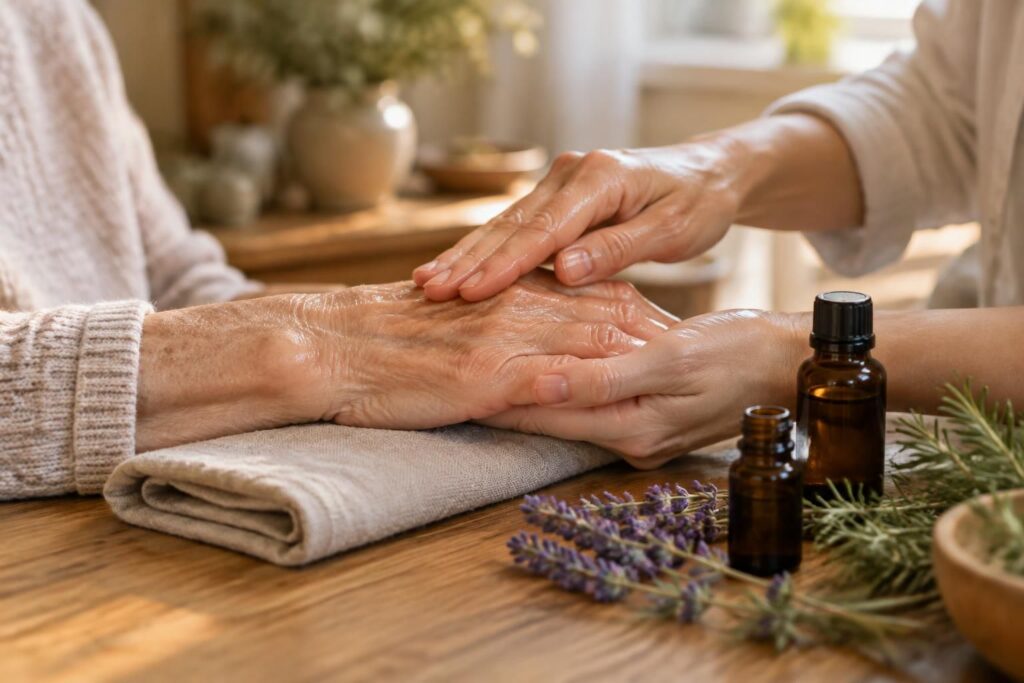
For someone like Nadia, who feels discomfort in the wrist during a flare-up, a gentle massage can become a comfort ritual. However, it should neither delay a consultation nor lead to changing a prescribed treatment. Additional guidance on essential oils and arthritis can help prepare the right questions to ask a professional.
Which essential oils to favor for joint pain?
The essential oils below are often cited in aromatherapy for muscle and joint comfort. Their benefit is mainly symptomatic, and tolerance depends on the person, the formula, and the application area.
| Essential oil | Traditional use or desired effect | Point of caution |
|---|---|---|
| Lemon eucalyptus | Used diluted in massage for comfort of sensitive areas. | May irritate or sensitize the skin; avoid the face. |
| True lavender | Appreciated for its scent and relaxing massage. | Perform a skin test and respect dilution. |
| Peppermint | Its cooling effect can provide temporary analgesic sensation. | Avoid in young children and near the eyes. |
| Ginger | Sometimes used in warming massage preparations. | Risk of irritation; do not apply on heated or damaged skin. |
| Wintergreen | Traditionally chosen for localized muscle pains. | Contains salicylates: important interactions and contraindications. |
| Italian Helichrysum | Present in some preparations for swollen areas. | Its effectiveness in arthritis is not established; seek advice. |
Wintergreen deserves particular caution: its methyl salicylate is related to salicylates. It should be avoided without medical advice in case of aspirin allergy, anticoagulant treatment, or medication likely to increase bleeding risk. An oil presented as “natural” remains an active concentrate.
The most reasonable choice is to favor a simple formula, adapted to the situation and verified by a pharmacist or doctor, rather than a complex ready-to-use synergy.
How to apply essential oils safely?
Massage: a local application always diluted
Essential oils must not be applied pure onto the skin. For an adult without contraindications, a professional can recommend a low dilution, often around 1 to 2% for local use; the dose varies depending on the oil and the person’s profile. Drops are not all the same volume, so it is better to follow a precise formula rather than improvise.
Apply the mixture around the joint, without pressing or massaging a red, hot, or very swollen area. In case of inflammatory flare-up, massage and heat can increase discomfort: stop the application if pain increases and seek advice.
Compresses and baths: be careful with skin contact
A cool compress can provide comfort when a joint is swollen, while gentle heat sometimes suits stiffness without acute inflammation better. The compress can be used without essential oil; if an aromatic preparation is considered, it must be properly diluted and validated by a professional.
Essential oils do not dissolve in bath water. Pouring them directly into the tub exposes the skin to concentrated droplets: an appropriate dispersant is needed, and it is better to refrain if in doubt or with reactive skin.
- Before first use: test a small amount of diluted preparation on a limited area and wait 24 hours.
- During application: avoid eyes, mucous membranes, wounds, and irritated areas.
- After massage: wash hands and stop if burning, itching, or redness occurs.
- If symptoms worsen: stop the product and seek medical advice, especially if the joint becomes very hot or swollen.
Aloe vera gel can be used as a skin care product depending on its composition and tolerance but does not neutralize improperly diluted essential oil. Information on the uses of aloe vera gel does not replace advice from a health professional.
What research says about aromatherapy against inflammation
Laboratory and animal model studies investigate the effects of molecules found in some oils, such as menthol or citronellal. These results help understand possible mechanisms but do not prove that a skin-applied oil reaches the joint in sufficient quantity or modifies the disease.
Clinical studies on aromatic massages are few and often small-scale. A massage can temporarily improve comfort thanks to touch, relaxation, and the sensation from the product; it is difficult to attribute the effect solely to essential oils. Promises of “guaranteed” relief or replacement of an anti-inflammatory are therefore unfounded.
For arthritis, the priority remains treating the cause and medical follow-up. Appropriate physical activity, physiotherapy, and medications prescribed by a doctor can be part of care; aromatherapy cannot replace them.
The value of a supplement is measured by its real usefulness and safety, not only by its plant origin.
Precautions and situations to avoid essential oils
An allergy, irritation, or drug interaction can occur even with skin application. Pregnant or breastfeeding women, children, asthmatic or epileptic persons, and those following chronic treatment should seek professional advice before any use.
Wintergreen is particularly discouraged in case of salicylate allergy or anticoagulant treatment and can pose problems with certain medications. Oils containing camphor, menthol, or cineole are not suitable for all ages or profiles: restrictions depend on the oil and its concentration.
Persistent joint pain, a red and hot joint, fever, or sudden loss of mobility justify prompt medical advice. These signs must not be masked by a scented preparation.
Precautions are not a detail: they determine whether complementary care is reasonable in a given situation.
Frequently asked questions about essential oils and arthritis
Can essential oils replace a treatment for arthritis?
No. They do not treat the cause of arthritis and do not replace prescribed medications or medical follow-up. Any treatment modification must be discussed with the doctor.
Which essential oil to choose for joint pain?
Lemon eucalyptus, lavender, or peppermint are sometimes used diluted locally for comfort. The choice depends on medical history and treatments; wintergreen requires particular caution.
Can wintergreen be used with an anticoagulant?
This combination should be avoided without medical advice. Wintergreen contains methyl salicylate, which may pose an interaction risk, especially with anticoagulants or in case of salicylate allergy.
How long should one wait before feeling an effect?
A sensation of coolness or relaxation can be felt quickly, but this does not mean that inflammation or the disease is treated. Stop application if it irritates the skin or increases pain.


