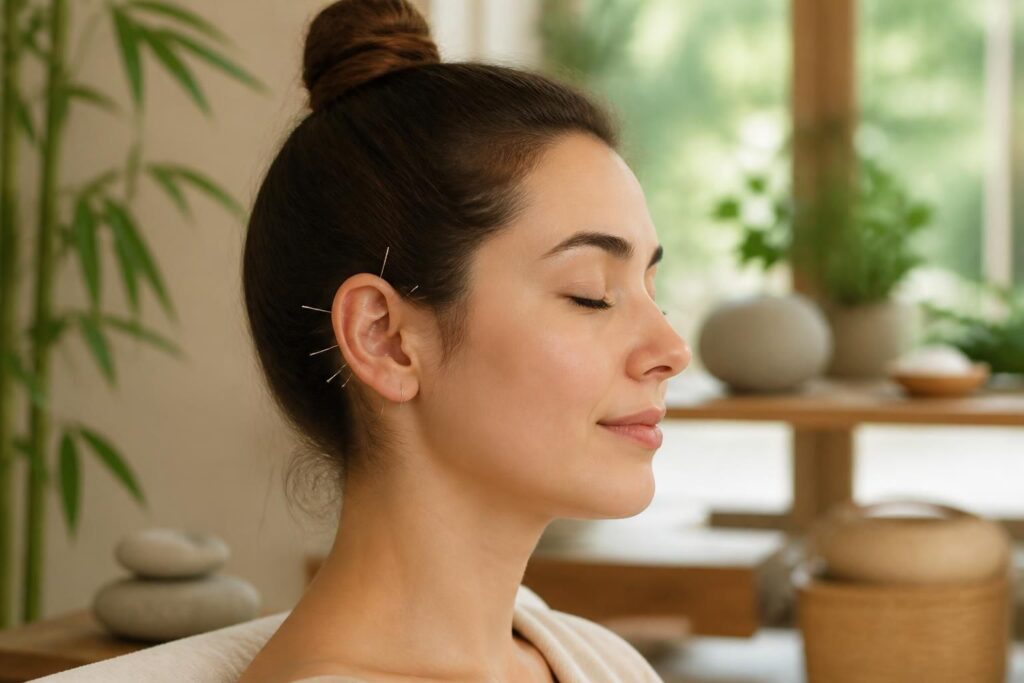
When pressure rises, thoughts spin in circles, and the body remains on alert, ear acupuncture is attracting more and more attention. This technique, originating from traditional medicine and revisited by modern research, relies on precise points of the auricle to promote relaxation, ease tensions, and support stress management without systematically resorting to heavy solutions. Between auricular reflexology, acupressure, and guided gestures, it now stands as a concrete support for better living through busy days.
Article summary
Ear stimulation is appealing for its simplicity, natural approach, and soothing potential on everyday stress. Between key points, precautions, and medical framework, the essentials come down to a few easy-to-remember landmarks.
- Shenmen, central landmark: the most cited point to promote nervous relaxation
- Varied and flexible gestures: needles, laser, seeds or manual pressure
- Action on stress: possible support of the autonomic nervous system
- Safety and common sense: medical supervision essential with needles
When used properly, auricular acupuncture can become a simple and concrete ally for better navigating periods of tension.
In today’s daily life, alert signals are everywhere: restless sleep, tense shoulders, saturated mind, shorter breath. It is precisely here that ear acupuncture takes full meaning, as it offers a discreet, targeted approach often appreciated by people seeking to soothe their stress without diverging from a progressive care logic. In a waiting room or after a tense week, many describe the same feeling: a return to calm that passes through the body before reaching the mind. This link between local stimulation and sensation of well-being explains the growing interest in this acupuncture technique, halfway between ancient heritage and scientific exploration.
A guiding thread often returns in practitioners’ feedback: students before an exam, overworked managers, exhausted caregivers, or parents who no longer find a true moment of rest. Not everyone has the same expectations, but many seek a natural, concrete solution compatible with their lifestyle. This is exactly what distinguishes auriculotherapy from other heavier approaches to integrate. When well thought out, it can complement habits like walking, slow breathing, or better-structured sleep, and become a regular support point in stress management.
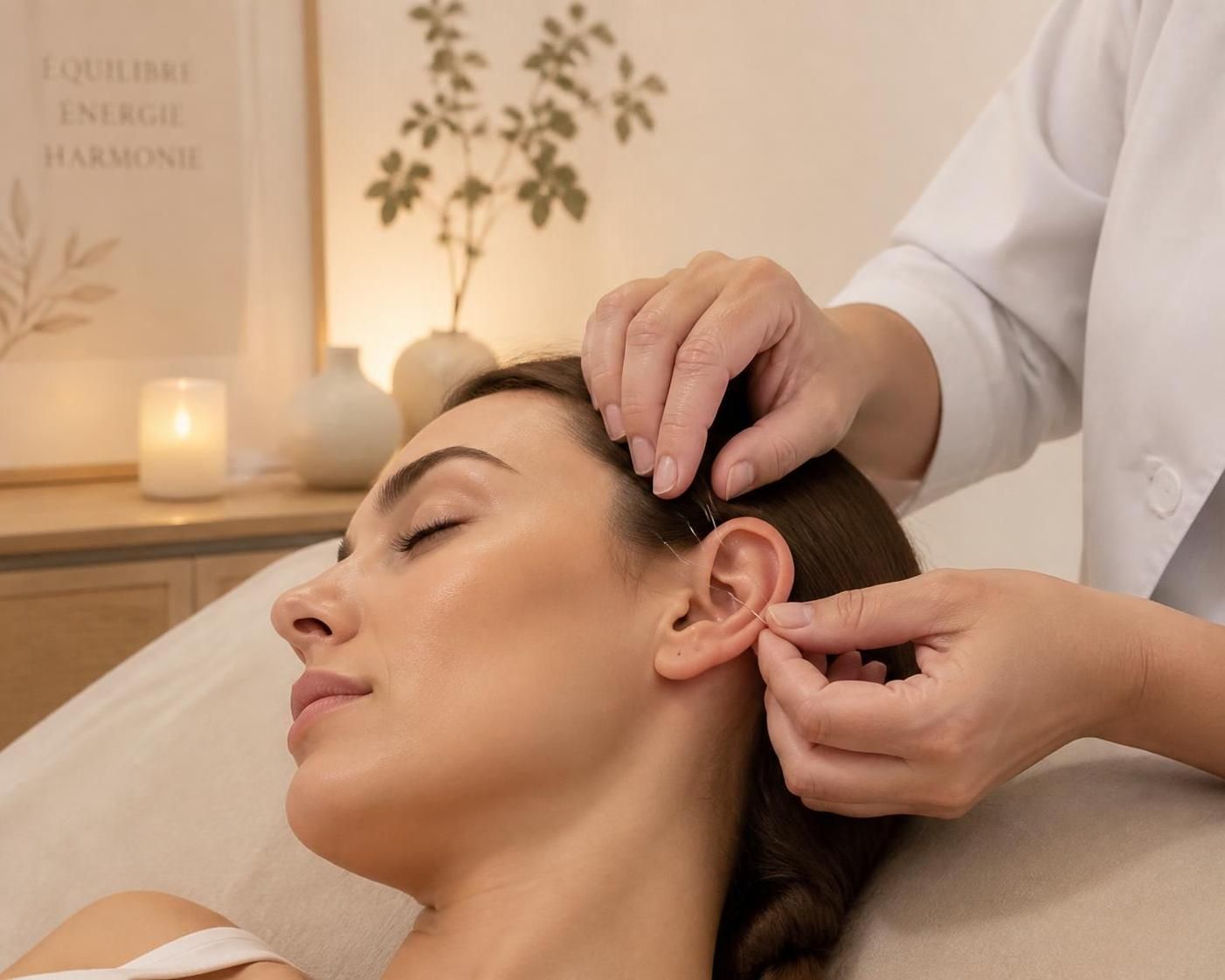
Why ear acupuncture is so interesting to soothe stress
The idea is based on a mapping of the auricle where each area would correspond to a function or bodily balance. Popularized in France by Doctor Paul Nogier, this reading of the ear gave birth to a practice now known as ear acupuncture or auriculotherapy. The image of the body projected onto the ear, often summarized as an inverted fetus, helps understand why a tiny point can be used to seek a global effect on relaxation. It’s not magic: it is an attempt to communicate with the nervous system through reflex pathways.
Contemporary data mainly focus on the proximity between certain ear zones and major nerve branches, notably the vagus nerve. This connection supports the hypothesis of modulation of the autonomic nervous system, with a possible effect on alertness, heart rate, and agitation sensation. For many people, the prospect is attractive because it links a simple gesture to a measurable physiological response. This explains why recent publications, such as those referenced in this file on acupuncture sessions against stress, are increasingly consulted by an audience seeking realistic solutions.
In practice, the expected effects do not depend on a single miracle point, but on a coherent set of stimulations. This recalls a very concrete idea: the body often reacts better to orchestration than to a single button. The auricle then becomes a bit like a dashboard, where each control contributes to a return to relaxation. It is this combined logic that gives strength to auricular reflexology.
The most cited ear points for stress management
In the most common protocols, Shenmen almost always comes first. Located in the triangular fossa, this point is associated with mental soothing, relaxation, and sometimes more peaceful sleep. Alongside it, other landmarks such as zones called “anxiety,” “adrenals,” “sympathetic,” or “heart” are mobilized according to the person’s profile and the nature of the tension felt. The goal is not to treat everything at once but to propose stimulation adapted to the experience of the moment.
To visualize these landmarks more clearly, a table helps compare their use, location, and the most frequent method of stimulation. In a well-organized office, this quick reading enables explaining to the patient why a certain point is chosen rather than another. It is often reassuring, especially when someone arrives after several short nights or a period of overload. In this context, clarity counts as much as the gesture itself.
| Auricular point | Location area | Commonly sought use | Frequent stimulation |
|---|---|---|---|
| Shenmen | Triangular fossa | Overall soothing and nervous relaxation | Acupressure, seeds, needles, laser |
| Sympathetic | Lower root of antihelix | Modulation of alertness | Needles or specialized stimulation |
| Adrenals | Lower tragus | Support during exhaustion or prolonged stress | Gentle pressure or micro-beads |
| Heart | Lower concha | Calm emotional oppression | Finger pressure or seeds |
| Be Happy | Back of the lobe | Feeling of emotional lightness | Gentle pinching of the lobe |
| Anxiety | Front of the lobe | Reduction of mental agitation | Light massage or patches |
The most documented point remains Shenmen, but effectiveness often builds through combination. It’s a bit like tuning a fuzzy radio: one knob helps, but several adjustments significantly improve listening. This synergy logic explains why serious practitioners avoid simplistic promises.
Shenmen, the most requested landmark
Shenmen is often presented as the “gate of the mind,” an expression that immediately resonates with tense people. The gentle pressure applied for a minute or more can accompany a moment of breathing pause, which sometimes suffices to reduce inner pressure. In a medical setting, this point can also be stimulated with sterile needles or plant seeds left for a few days.
A reader accustomed to fragmented nights after a period of intense mental load often finds it easier to appropriate this point than an abstract discourse on neuromodulation. This type of concrete landmark turns a complex notion into a simple gesture. It is one of the major assets of auricular reflexology: making soothing accessible.
The reflex points that complement the action
The lobe, tragus, or root of the antihelix often serve as relays when stress expresses itself through bodily tensions, tight throat, or persistent irritability. Modern protocols sometimes add landmarks with very telling names, such as “Be Happy,” to facilitate appropriation by the public. Even if these names are not all part of official nomenclature, they help memorize a map often judged intimidating at first.
This more accessible vocabulary does not detract from the necessary caution: a point does not replace medical advice if anxiety becomes overwhelming or if worrying physical symptoms appear. It is a support, not a replacement. This nuance is essential to maintain a useful and safe practice.
How auriculotherapy works on the nervous system
Biologically, ear stimulation could act like a signal sent to the brain via sensitive nerve fibers. Recent research especially focuses on the auricular branch of the vagus nerve, which plays a role in balancing activation and calm return. In other words, the idea is to encourage the autonomic nervous system to slightly release the emergency brake constantly triggered by stress. This hypothesis aligns with clinical observations where heart rate and certain variability measures seem to change after the session.
Studies published in scientific journals and syntheses available on databases like PubMed Central also report a temporary drop in salivary cortisol in some stress contexts, notably before an exam or around a medical procedure. This does not mean the ear acts as a universal command but rather that it can participate in broader regulation. The body, again, often responds to a set of signals rather than isolated action. For people also suffering from restless nights, a useful complement may be to consult practical landmarks on improving daily sleep.
This approach resonates with those who feel stress up to the muscles of the neck, jaw, or trapezius. When a protocol brings overall relaxation, it acts like a temporary break in the hypervigilance mechanism. The real interest, deep down, may be here: to offer a moment when the body stops running after the next alert signal.
Which method to choose between needles, laser, and acupressure
The term ear acupuncture actually covers several ways to stimulate the auricle. Needles are reserved for the medical setting, while acupressure, athermal laser, or adhesive seeds come under a non-invasive approach. For someone who fears medical gestures, the existence of these alternatives greatly changes the perception of care. It also allows adapting the method to the age, sensitivity, and current stress level.
The following table summarizes the most common options and associated precautions. It helps distinguish what falls under medical acts from what can fit into a supervised wellness routine. In practice, this distinction is essential, especially when seeking to soothe without taking unnecessary risks.
| Method | Nature | Typical duration | Key precaution |
|---|---|---|---|
| Sterile needles | Invasive | 20 to 45 minutes | Performed only by an authorized professional |
| Athermal laser | Non-invasive | A few seconds per point | Mandatory eye protection |
| Manual acupressure | Non-invasive | 1 to 2 minutes per area | Avoid irritated or damaged skin |
| Adhesive seeds or beads | Semi-permanent | Several days | Monitor redness and heat |
In a health office, the use of needles requires real supervision. In France, the skin penetration act is reserved for trained health professionals, while non-perforating methods can be offered in a different setting. This regulatory point protects both the patient and the quality of practice and deserves to be known before booking a session. For those who wish to compare approaches around stress, this guide on acupuncture sessions and stress provides useful insight.
One often overlooked detail, however, changes everything: the quality of the context. Soft lighting, clear explanations, practitioner listening, slowed breathing. The soothing effect sometimes depends as much on these parameters as on the gesture itself, which in no way detracts from the interest of the method, quite the opposite.
What a session looks like and what precautions to keep in mind
A serious session begins with an exchange about the causes of stress, sleep, possible pain, and health history. Then, the practitioner observes the auricle, identifies sensitive areas, and chooses appropriate stimulation. Some people feel a slight warmth, others immediate relaxation, and others a progressive effect over one or two days. This diversity of responses is normal and should not be confused with failure.
However, there are signals that require not to trivialize the situation. Chest pain, shortness of breath, sudden dizziness, sudden tinnitus, or significant balance disorders require urgent medical advice, not a relaxation session. The same vigilance applies in case of pregnancy, anticoagulant treatment, or coagulation disorder. Common sense remains the best compass.
To prolong effects between appointments, a few simple gestures often suffice to make a difference. It can involve gentle self-massage of the lobe, long breathing at the end of the day, or a brief ritual before bedtime. In periods of tension that also affect bodily pain, it is sometimes useful to learn about related subjects such as how a pain center works, to better understand when a complementary approach is relevant.
What stands out most from experience feedback is the ease of use. A discreet, unobtrusive, adaptable, and often reassuring technique has every chance to be maintained over time. And in stress management, regularity often weighs more than a single big gesture.
How to integrate auricular reflexology into a calming routine
The most cautious routine always starts with a clean ear, without redness or visible wounds. Then, a light rubbing of the auricle, from top to bottom, can warm the area before gentle pressure on Shenmen or the lobe. The gesture is nothing spectacular, but that is precisely what makes it easy to repeat daily. For many people, this repetition creates an appointment with themselves, very precious when days follow one another without a break.
A simple list helps keep on track without turning the ritual into a constraint:
- Check the ear’s condition before any stimulation
- Warm up the auricle with slow and gentle movements
- Moderate pressure on Shenmen or the targeted area
- Slow breathing to accompany relaxation
- Stop immediately in case of clear discomfort
This self-care logic recalls a very simple lesson, often repeated by wellness specialists: small gestures matter more than you might think. Like a hiking grandfather would gladly say after a long climb, health is built on modest but persistent habits. Here, the ear becomes a discreet anchor point, almost a calm switch within reach.
When auricular acupuncture complements other approaches
The interest of this method increases further when it fits into a coherent whole. Breathing, gentle physical activity, more regular eating, better-protected sleep, and psychological support if needed form a stronger base than an isolated strategy. This is what makes it interesting in real life: it does not ask to change everything, only to add a targeted gesture to a more attentive lifestyle.
In some cases, auriculotherapy is used for support during particular periods, such as an exam, work overload, or an episode of nervous fatigue. Others appreciate it to recover better after a prolonged period of tension, especially when the body has started to speak in its own way. If fatigue persists despite sufficient sleep, another perspective may be useful, notably with the causes of fatigue despite sleep.
This complementary positioning also explains why more and more patients see ear acupuncture as a transition tool: not a total answer, but a credible support. It is often enough to regain some breathing room, some stability, and a better margin of maneuver against busy days.
What is the most used point to calm stress?
The Shenmen point remains the most frequently targeted landmark to promote soothing, mental relaxation, and better bodily release. It is often combined with other auricular zones for a more global effect.
Can ear acupuncture replace medical treatment?
No, it acts as a complementary support. In case of chronic anxiety, severe crisis, or worrying symptoms, medical care remains essential.
Is the method painful?
Stimulation by acupressure, laser or seeds is typically very well tolerated. With needles, the sensation most often feels like a slight tingling or a brief pressure.
How many sessions are needed to feel an effect?
Some people notice relaxation from the first session, while others observe improvement after several spaced appointments. The response depends on stress level, context, and individual sensitivity.
Who can perform needle treatment in France?
Skin penetration is strictly regulated and reserved for certain trained health professionals. Non-invasive methods like acupressure or laser fall under a different framework, distinct from medical acts.


