When days follow one another between screens, reading, and slight eye strain, the eyes eventually demand a real break. Orthoptic exercises at home do not replace medical care, but they can help relieve eye fatigue, regain some ocular flexibility, and establish simple daily useful gestures. Well-targeted, these reflexes support vision without miracle promises, with a very practical logic: to spare the muscles, vary distances, and recognize early signs that warrant professional advice.
The article in brief
A few well-chosen minutes can already change the visual comfort of a busy day. The essential thing is to distinguish relaxation gestures at home from genuine supervised visual rehabilitation.
- Anti-fatigue ritual: simple breaks to relax the eyes after screen time
- Targeted exercises: fixating, following, bringing closer without forcing or doubling
- Supervised rehabilitation: only the orthoptist sustainably treats certain disorders
- Useful routine: short habits to preserve eye health
This article helps sort out immediate relief, eye training, and real medical care.
In many households, visual fatigue settles quietly. A child skipping lines while reading, an adult squinting after a meeting, a middle schooler complaining of headaches at the end of the day: these signals often resemble each other. The good news is that there are simple gestures to integrate at home to protect vision and prevent discomfort from taking over completely. However, vigilance remains essential, as all exercises do not pursue the same goal. Some serve to rest, others to rehabilitate, and only a professional evaluation can determine what is appropriate.
This distinction changes everything. Relaxation gestures act like breathing for overworked eyes, while visual rehabilitation in a clinic aims for precise visual strengthening, often useful in cases of convergence disorders, amblyopia, or strabismus. In daily life, many still confuse wellness exercises with medical acts; experience at mutual insurance has often shown this, with people convinced that simple home training could fix everything. However, vision works like a duo: when coordination is weakened, a serious framework is needed to put both eyes back in sync.
Orthoptic exercise at home: simple gestures that really relieve
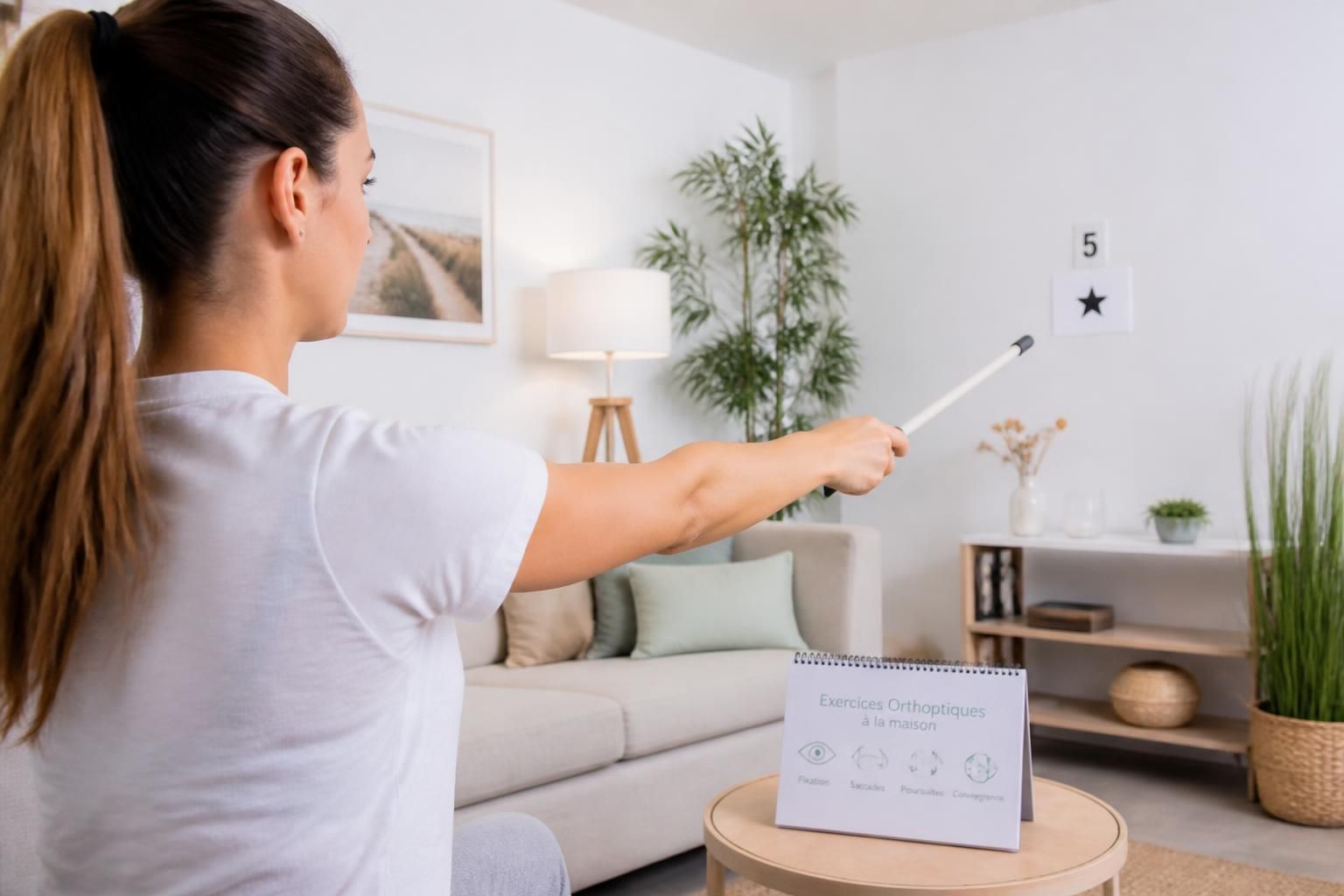
Screens have transformed our visual habits, sometimes to the point of tiring the eye muscles even before the end of the day. To regain some comfort, certain simple gestures can be practiced at home without sophisticated equipment. They are not meant to “repair” an established disorder, but they help reduce tension, vary effort, and offer the eye a welcome recovery. This is exactly where common sense meets eye health.
The 20-20-20 rule to break the screen rhythm
Widely used in prevention, this method is based on a clear idea: every 20 minutes, look away for 20 seconds at a point about 6 meters away. The aim is not to make the eyes work harder, but on the contrary to relax accommodation, this “internal zoom” that gets stuck when you read or work up close.
A concrete example: in an open space office, an employee can look up at a distant window between tasks. This mini-break acts like a valve. Repeated regularly, it helps limit eye fatigue and maintain more comfortable vision over time.
Palming to offer true restful darkness
Palming consists of slightly warming the hands, then cupping them over closed eyes without pressing. A few calm breaths are enough to create a moment of complete darkness. This gentle darkness, combined with the warmth of the palms, promotes a form of recovery after prolonged exposure to screens.
In an end-of-day routine, this gesture can make the difference between a “saturated” gaze and a clearer feeling of relaxation. It integrates easily after work or before bedtime, especially when the eyes have spent hours alternating between blue light, documents, and notifications.
The pencil, useful only with caution
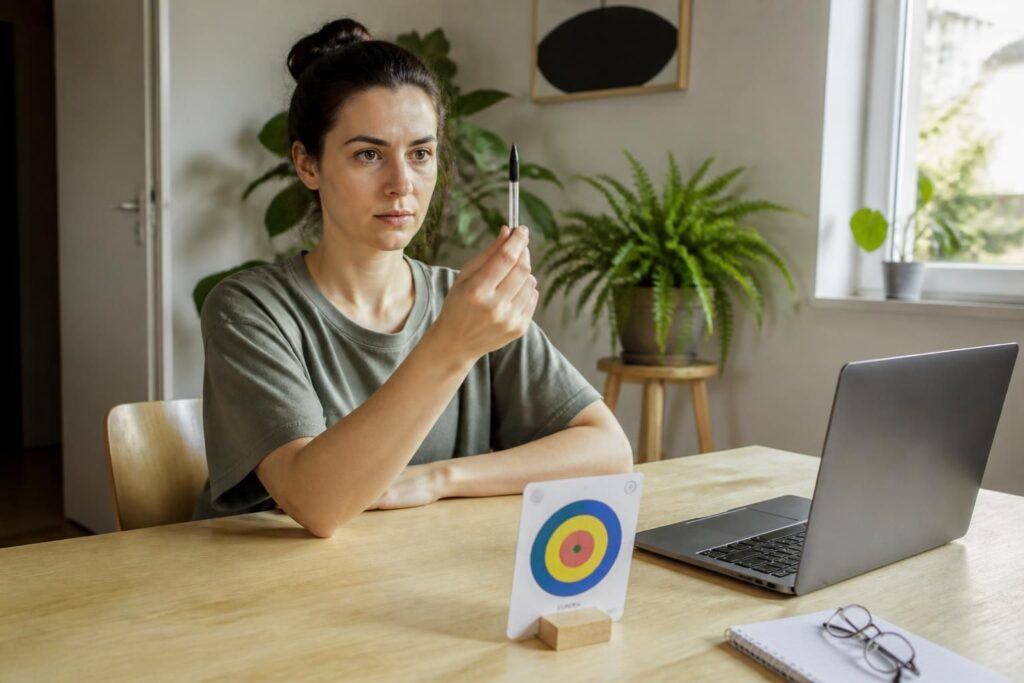
The famous pencil exercise is often associated with strengthening convergence. It involves fixing an object held at arm’s length, then slowly bringing it closer to the nose while trying to keep it sharp and singular. As soon as the image doubles, you must stop and go back.
This point of caution is critical: forcing can worsen an existing imbalance. For a teenager who struggles with prolonged reading, for example, a poorly dosed exercise can increase discomfort instead of reducing it. The rule remains simple: no pain, no persistent double vision, and never insist excessively.
| Gesture | Visual Objective | Practice Duration | Attention Point |
|---|---|---|---|
| 20-20-20 rule | Relax accommodation | Every 20 minutes | Look far, without effort |
| Palming | Soothe tired eyes | 1 to 2 minutes | Do not press on the eyeballs |
| Pencil | Work convergence | Several repetitions | Stop as soon as the image doubles |
These gestures are useful because they are simple, short, and easy to repeat. Their effectiveness depends less on intensity than on regularity. This is often where the difference lies: in the ability to install a visual break before fatigue accumulates.
Visual rehabilitation: when home exercises are not enough
Sometimes it is necessary to go beyond breaks and relaxation tips. When the two eyes struggle to work together, when reading becomes uncomfortable, or headaches recur despite adjustments, visual rehabilitation in a clinic takes over. Here, the goal is no longer just to relieve but to correct a disorder with method and follow-up. This step is based on an assessment, then on a personalized program defined by an orthoptist.
What really happens during a session
In the clinic, the professional uses precise tools to guide the gaze and stimulate coordination. Prism bars compensate for misalignment, stereograms work on depth perception and dissociation of effort, while some more complex devices stimulate eye muscles under control. Nothing is left to chance: each exercise has a clear function, exactly as a coach would adapt a session to a beginner or experienced runner.
A session usually lasts about twenty minutes, and a cycle can include around ten to fifteen appointments depending on the need. The idea is not to further tire the eyes but to automate new visual reflexes. In the long term, clear vision should become less costly.
Why professional supervision makes a difference
Improper eye training never replaces a diagnosis. A child who confuses letters, an adult who needs to hold their phone away to read, or a person experiencing persistent discomfort in near vision may require a very different strategy depending on the origin of the disorder. Follow-up avoids bad habits, adjusts intensity, and progresses without putting vision at risk.
This approach is also reassuring. We know exactly why an exercise is suggested, how it works, and when it should be modified. In 2026, supports have even diversified with sheets, videos, and more interactive educational tools, but the principle remains the same: the professional framework protects and guides.
Good habits to strengthen vision without exhausting the eyes
A good home program does not rely on performance but on a flexible routine. Ten well-thought-out minutes are better than a session that is too long and ends in tension. For children, the playful aspect helps a lot; for adults, it is mainly simplicity that ensures regularity. In both cases, the environment matters as much as the gesture itself: soft light, calm pace, clear instructions.
- Choose a fixed time: after school, after work, or before bedtime.
- Start short: a few minutes are enough to avoid visual exhaustion.
- Vary supports: paper, video, everyday objects, according to available attention.
- Observe signals: squinting, loss of concentration, double vision.
- Encourage progress: regularity weighs more than intensity.
This logic applies well to a family where a parent supports a child after school. A calm 10-minute time, always in the same place, is often enough to create a reassuring ritual. When the environment is peaceful, exercises become easier to accept and less associated with effort.
| Situation | Recommended gesture | Goal sought | When to consult |
|---|---|---|---|
| Prolonged screen work | 20-20-20 rule | Limit eye fatigue | If discomfort persists despite breaks |
| End-of-day tension sensation | Palming | Relax the eyes | If pain recurs often |
| Difficulty focusing | Pencil exercise with caution | Test convergence | If double vision or marked discomfort |
| Lasting fatigue or known disorder | Orthoptic assessment | Personalized rehabilitation | As soon as the symptom settles |
Eye health is often built in those tiny details repeated unconsciously. A gaze resting at the right time, an exercise done without forcing, a consultation taken on time: that is what yields real results. Small gestures matter, but they gain effectiveness when embedded in a coherent logic.
Orthoptic exercise at home: useful markers to progress safely
The boundary between maintaining visual comfort and medical rehabilitation must remain very clear. At home, the main goal is to relieve and preserve. In the clinic, the goal is to correct and automate. This nuance prevents many mistakes, especially when eye fatigue masks a real disorder of coordination between the two eyes.
To stay on track, it is better to remember a simple rule: if the gestures provide temporary improvement, they have their place in the routine; if symptoms persist, worsen, or recur constantly, an assessment is necessary. It is often at this moment that the smallest signal becomes the most useful. As a grandfather passionate about hiking often reminded, health is played out in small repeated steps, not in great leaps.
How long should an orthoptic exercise be practiced at home?
A few minutes are enough, especially for relaxation gestures. Short sessions are easier to maintain and reduce the risk of additional fatigue.
Can home exercises correct a convergence disorder?
They can help relieve or maintain visual comfort, but they do not replace supervised visual rehabilitation when a disorder is established.
What to do if vision blurs during eye training?
You must stop the exercise immediately, avoid forcing, and seek professional advice if the problem recurs or is accompanied by double vision.
From what age can these simple gestures be proposed?
It depends on the child’s attention and the observed problem. An orthoptist can determine suitable exercises and their difficulty level.


