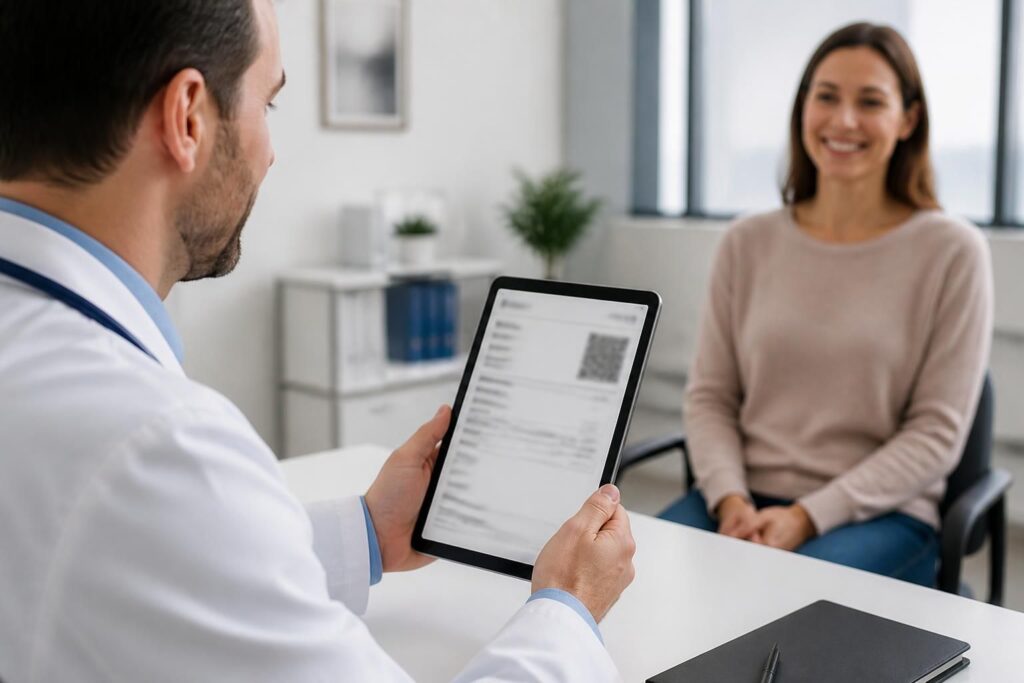
In a medical daily life where everything moves faster, the secured prescription provides a very concrete answer to a demand that has become central: better protecting the confidentiality of medical treatments. By combining medical digitization, traceability, and access control, it strengthens the medical secrecy while limiting errors, document loss, and fraudulent uses. For patients as well as caregivers, it is one more step towards a health system that is more fluid, safer, and better equipped for the protection of patients.
The article in brief
The secure digital prescription changes the game: it simplifies the care pathway while strengthening data confidentiality. Between fraud prevention, better coordination, and easier access to documents, it establishes a new demand for trust.
- Enhanced confidentiality: better controlled access to sensitive prescriptions
- Useful traceability: every step of the treatment remains recorded
- Less fraud: the prescription becomes more difficult to falsify
- Smoother pathway: prescriptions follow the patient better
This evolution brings prescription security closer to a simpler, clearer, and more protective care experience.
For a long time, the paper prescription played its role, but it also left blind spots: lost document, approximate transcription, copy circulating without real control, or too wide access to sensitive information. With the secured prescription, the logic changes: personal data is better framed, the prescription becomes verifiable, and the circuit between doctor, patient, and pharmacist is carried out with greater rigor. It’s a bit like moving from a fragile handwritten letter to a file protected by several digital locks.
This evolution is not only technical. It responds to a very concrete public expectation, often recalled in field exchanges: wanting to understand who sees what, when, and in what context. The question is no longer only “how to prescribe?”, but also “how to preserve discretion around the treatment?”. This is where secure electronic prescribing makes complete sense, by making the circulation of information cleaner, clearer, and better controlled.
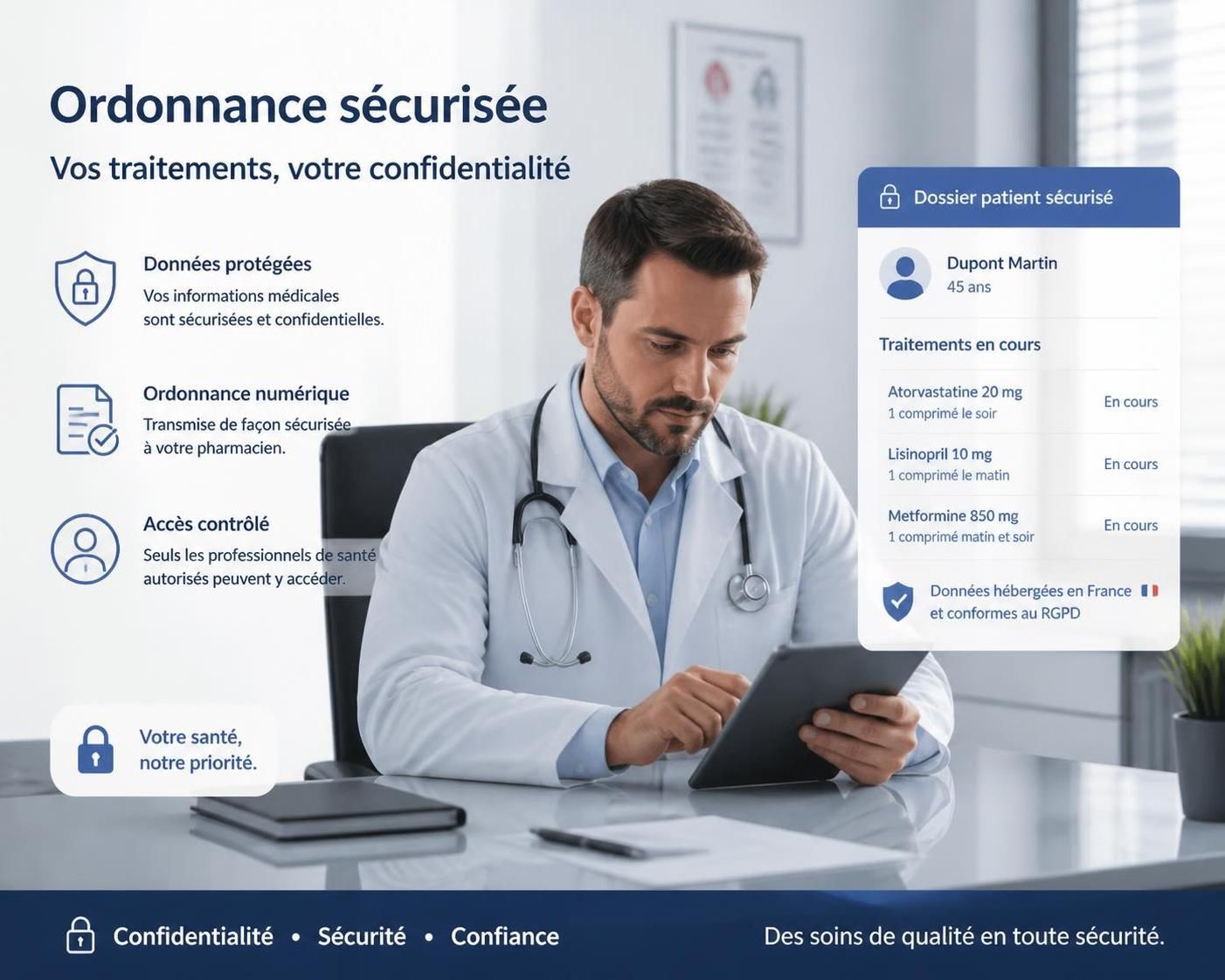
Secured prescription and confidentiality: why this format changes the game
A secured digital prescription does not just replace paper. It structures the information, authenticates the issuer, and limits possible manipulations, which greatly reduces the risks of falsification or involuntary disclosure. In practice, this better protects sensitive treatments, whether they are strong painkillers, long-term care, or situations where discretion matters greatly to the patient.
This confidentiality gain is particularly visible when several professionals are involved around the same pathology. A well-framed prescription avoids careless copies, document losses, and imprecise transmissions. For people who fear that their medical journey is too exposed, this added security can truly change the relationship to care.
A stronger personal data protection
The main advantage of the secured prescription is that it does not just “digitize” a document. It embeds the prescription in an environment that frames the prescriber’s identity, access to content, and information storage, with certified health hosting and strict interoperability rules. Result: personal data linked to medical treatments is less vulnerable than with a simple PDF sent by email or hastily printed.
This logic recalls a simple but often unknown principle: not every digital tool offers the same level of protection. A scanned prescription remains an image, whereas a secure e-prescription functions like an organized file, readable by the right actors and much less exposed to unnecessary detours. For confidentiality, the difference is major.
- Enhanced authentication: the prescription issuer is clearly identified
- Complete traceability: the dispensing steps remain viewable
- Controlled access: sharing is done with secure tools
- Fewer risks of error: manual transcription is significantly reduced
Prescription security: how e-prescribing limits fraud
Fraud prevention is among the most visible promises of the secured prescription. A prescription difficult to divert, modify, or reuse protects the patient, pharmacist, and the entire health system. This is especially important for sensitive medications, expensive procedures, or situations where falsification can have serious medical and financial consequences.
In 2025 and 2026, the movement accelerates in both usage and the rules of the game. City professionals have passed a milestone with now widely generalized adoption, while hospitals follow a progressive trajectory. In practice, this means less gray area, more coherence, and a prescription more difficult to circumvent.
| Medium | Security level | Risk of loss or falsification | Interest for confidentiality |
|---|---|---|---|
| Classic paper prescription | Medium | Higher | Less controlled sharing |
| Scanned prescription | Low to medium | Risk of uncontrolled copying or sending | Limited protection |
| Digital secured prescription | High | Greatly reduced | Better controlled access and traceability |
In a neighborhood pharmacy, this translates into faster and more reliable processing. A patient presenting a QR code associated with their prescription benefits from immediate control, while the professional knows they are working on authenticated information. Security is then no longer a regulatory abstraction: it becomes a concrete gesture at the counter.
The role of QR code in the trust chain
The QR code acts like a reading key, not as a simple digital decoration. It allows opening the right prescription at the right time, without multiplying manipulations. This simplicity matters a lot, because the shorter the circuit, the less data circulates unnecessarily.
In some cases, a patient can also more easily transmit their prescription to another authorized professional, for example, for coordinated follow-up. The pathway remains clearer, which is valuable when consulting a doctor remotely, changing pharmacy, or preparing long-term treatment. Confidentiality then gains clarity as well as robustness.
Medical digitization and patient pathway: very concrete daily benefits
Medical digitization is not only used to modernize tools. It can also lighten patients’ lives, especially when medical treatments are long-term. My Health Space, the shared file, and secure exchanges make it easier to find a prescription without rummaging through folded papers at the bottom of a bag.
For someone monitored after surgery, or for a chronic patient who chains appointments, this continuity changes everything. Information circulates better between professionals, while remaining more discreet. It’s a precious balance: more coordination without sacrificing medical secrecy.
A telling example: during a follow-up consultation, a patient may receive a prescription integrated into their digital space, then present it at a compatible pharmacy. The pharmacist then accesses the correct data, without improvisation or re-entry. For the patient, this means less waiting, less forgetting, and better control of their pathway.
Usages that also simplify everyday situations
This logic is especially useful when access to care requires flexibility. A person isolated geographically, with reduced mobility, or followed remotely can receive a prescription without multiplying trips. In this context, digital acts as a bridge: connecting steps without unnecessarily exposing health information.
To go further in understanding care pathways, some related usages well illustrate this evolution, such as rapid guidance devices to the pharmacy or accompaniment teleservices. In this respect, a subject like the angina test in pharmacy clearly illustrates the rise of smoother services, while access to care facilitated by digital shows how connected tools can make care more accessible. The secured prescription is fully part of this dynamic.
Regulatory framework, hospital and city: towards wider generalization
The national framework clearly promotes wide adoption of the secured prescription. After its rollout in the city, the challenge shifts to the hospital, where integration with business software, electronic patient record, and hospital information systems becomes decisive. The objective, by 2030, is to move towards a more homogeneous, more traceable, and better coordinated prescription circuit.
This rise no longer concerns only medications. Biology, imaging, and medical acts are progressively entering the same securing logic. This may seem very technical, but the idea is simple: avoid each care step relying on isolated documents when everything should function as a coherent whole.
Key points to remember for professionals
For caregivers, the success of the system depends as much on the tool as on the organization. A secured prescription works well when the business software, prescribing assistance, storage, and transmission properly communicate with each other. Without this coherence, the benefit is reduced; with it, the routine becomes more reliable and smoother.
This framework also requires particular attention to patient consent. Even with a strictly controlled system, data management remains essential. It is a way of reminding that technology must serve the care relationship, and not the other way around.
- Clearly identify the prescriber thanks to appropriate authentication tools.
- Limit re-entries to reduce errors and duplicates.
- Keep useful traces without unnecessarily exposing data.
- Organize sharing between city, hospital, and pharmacy securely.
| Actor | Main benefit | Effect on confidentiality |
|---|---|---|
| Doctor | Faster and better-followed prescription | Fewer transmission errors |
| Pharmacist | Reliable reading and simplified dispensing | Limited access to necessary information |
| Patient | Retrievable and shareable prescription | Better control of personal data |
| Establishment | Reinforced coordination between services | Clearer traceability of the care circuit |
In this perspective, the best secured prescription is not necessarily the most sophisticated, but the one that naturally integrates into field usages. When a system protects without complicating, it quickly becomes an everyday ally.
Does a secured prescription really protect confidentiality?
Yes, because it frames authentication, storage, and transmission of prescriptions. Accesses are better controlled than on paper or scanned documents.
Can patients consult their digital prescriptions?
Yes, they can be found in My Health Space according to the planned pathway. This facilitates monitoring without multiplying paper copies.
What happens if the pharmacy is not equipped?
The prescription can then be treated as a classic paper prescription. However, the deployment aims to gradually reduce these situations.
Does the secured prescription completely replace paper?
Not immediately. The transition is done in stages, with progressive adoption in the city then in hospitals, to ensure continuity of care.


