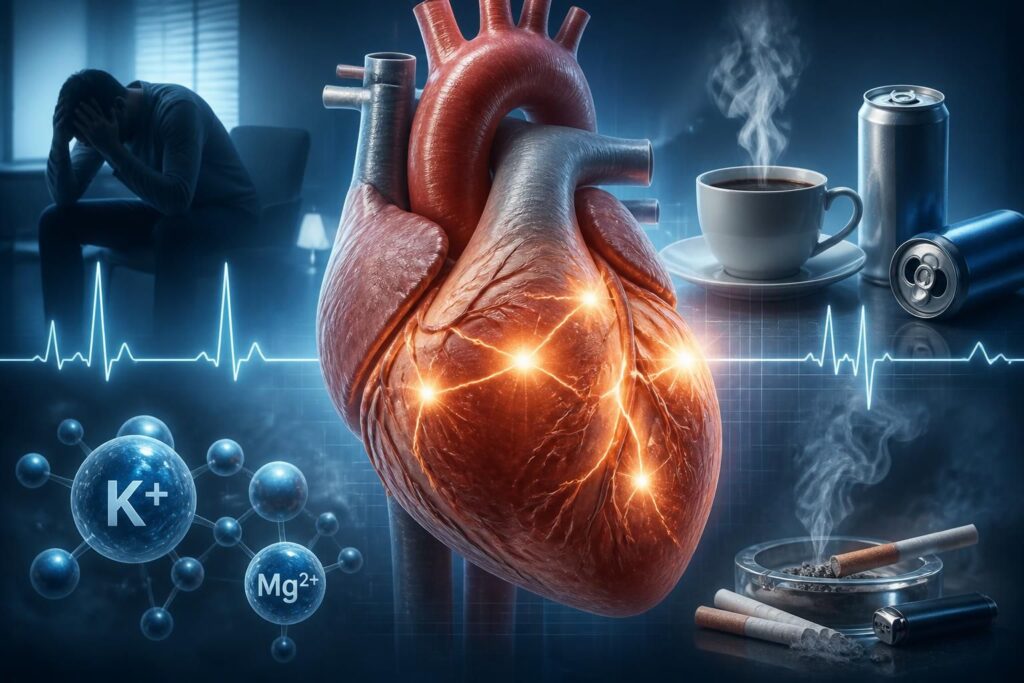
A heart that races, skips a beat, or feels like it’s making a slight mistake can quickly cause worry. Extrasystoles are, however, very common and, in many cases, harmless in a healthy heart. Understanding their common causes helps to distinguish between a temporary phenomenon related to stress, caffeine or fatigue, and a cardiac arrhythmia that requires a more thorough assessment.
The article in brief
Irregular beats related to extrasystoles are often impressive, but their origins are most often identifiable and sometimes easy to correct. Identifying triggers, knowing when to consult, and understanding warning signs really makes a difference.
- Everyday triggers: stress, caffeine, tobacco and fatigue often recur
- Signals to watch for: pain, discomfort or shortness of breath require medical advice
- Medical causes: ionic disorders, heart problems and certain medications
- Useful reflexes: symptom diary, lifestyle habits and appropriate cardiological assessment
Better understanding extrasystoles is already starting to tame them daily.
Extrasystoles often give the sensation of a heart that “misses” a beat, then restarts stronger, like an orchestra playing a note too early. This feeling can occur in healthy people, but it can also reveal a more sensitive condition, especially if episodes become frequent, poorly tolerated or associated with other symptoms. In 2026, teleconsultation allows part of the evaluation to be directed, but the clinical examination and ECG remain essential landmarks to specify the origin of these irregular beats.
In real life, many patients describe these episodes after a busy day, an excess of coffee, a short night, or a tense moment. It is no coincidence: the heart also reacts to the environment, somewhat like a metronome sensitive to the shocks of daily life. The most important thing is to identify what triggers, what soothes, and what should alert, to avoid both unnecessary worry and delayed care.
Extrasystoles and irregular beats: what you need to understand
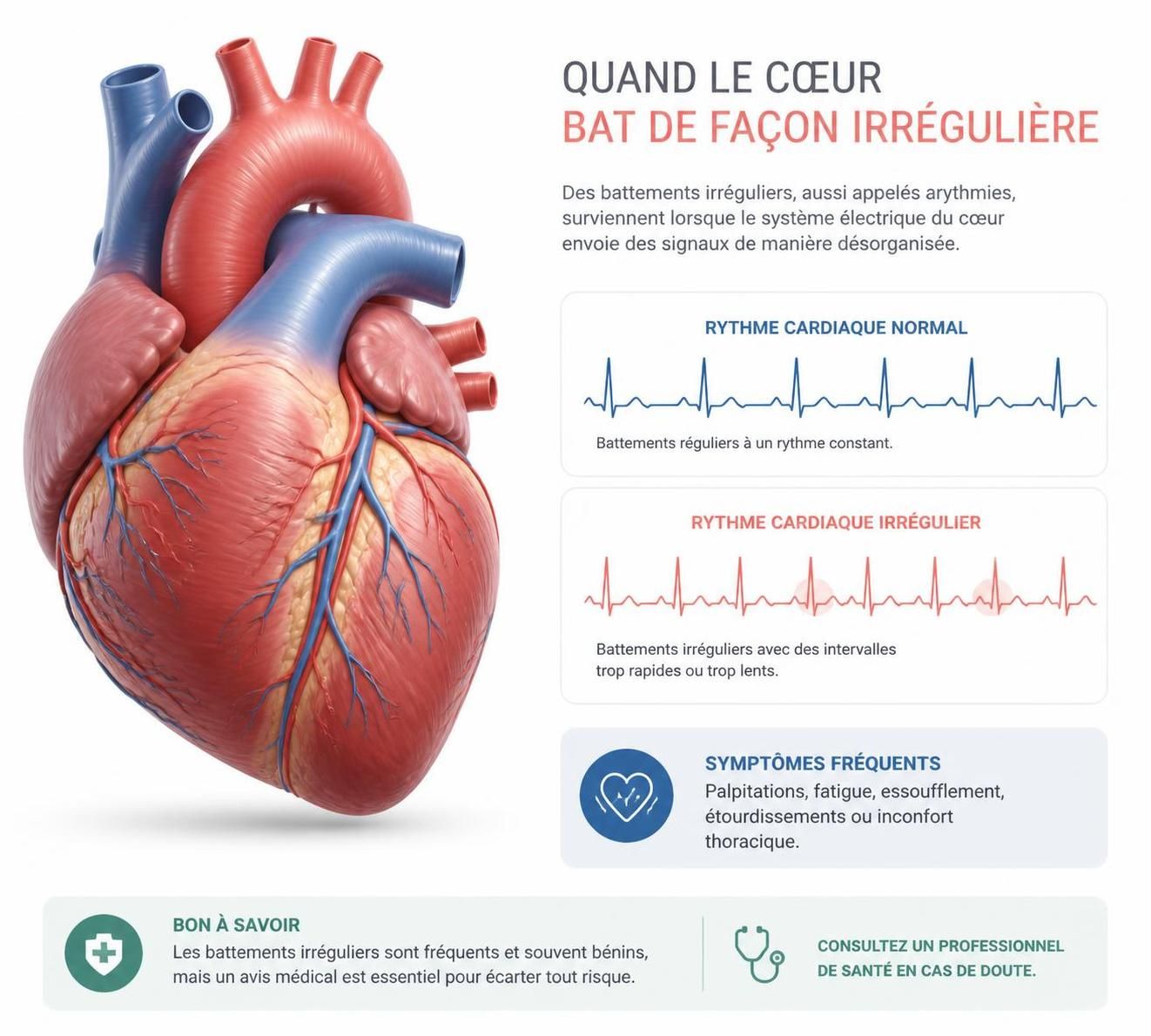
An extrasystole corresponds to a heart contraction that occurs earlier than expected in the normal cycle. It can come from the atria or the ventricles, these two levels of the heart that coordinate its rhythm like a well-tuned team. When this coordination briefly malfunctions, the person often feels a “jab,” a pause, or a stronger beat immediately after.
The good news is that this phenomenon remains very common. Public health data in France show that a large proportion of adults have at least some extrasystoles over time, often without consequence. The context matters more than the isolated number: irregular beats in a healthy heart do not have the same significance as extrasystoles associated with heart disease.
Why the sensation seems so striking
The brain perceives cardiac rhythm variations very well. A simple premature beat can feel like a big stretch, whereas sometimes it is just a brief and isolated event. This impression explains why some people become more anxious than the actual medical risk justifies.
A common example: a person notices their extrasystoles mainly when calm, in the evening, when everything becomes quiet. Conversely, they may go unnoticed during a walk or sustained activity. So the sensation does not tell the whole story, and this is precisely where a well-conducted assessment makes all the sense.
Common causes of extrasystoles in daily life
Common causes are often related to lifestyle. Stress, caffeine, smoking, fatigue and alcohol are among the most classic triggers. In some people, just one extra cup of coffee, a very busy week, or a shortened night is enough to bring on palpitations.
Stress acts like an accelerator on the autonomic nervous system. It prepares the body to react quickly, which can disturb the heart’s electrical stability. Caffeine maintains this excitability, while smoking weakens the cardiovascular system and promotes sensations of a “disrupted” heart.
When lifestyle matters more than you think
Extrasystoles often appear in small clusters, never without a clear reason. A period of mental overload, too heavy meals, insufficient hydration, or lack of sleep create a favorable environment. In some patients, simply reducing stimulants and recovering a regular rhythm significantly lowers the frequency of episodes.
In a former health insurance, many people already confused prevention with curative care. This confusion remains common: here, prevention means acting on triggers before they cause a vicious cycle between worry, palpitations and excessive pulse monitoring. A small daily adjustment can sometimes have a much more visible effect than imagined.
Medical causes not to be overlooked
When extrasystoles cannot be explained solely by lifestyle, other avenues must be considered. Heart problems such as coronary artery disease, heart failure or valvulopathy can promote these irregular beats. In this context, the extrasystole becomes less a simple nuisance than a signal to be explored.
Biological imbalances also play an important role. A lack of potassium or magnesium can disturb the heart’s electrical conduction, somewhat like a poorly connected cable in a sensitive network. Some endocrine diseases, notably hyperthyroidism, can also accelerate the rhythm and make extrasystoles more frequent.
The role of certain medications and substances
Some medications can favor or amplify the episodes, especially when they stimulate the nervous system or alter the heart rhythm. This is the case with certain bronchodilators, theophylline, poorly balanced antiarrhythmic treatments, or products acting on the cardiovascular system. Hence the importance of always reviewing current medications during a consultation.
Some supplements or stimulants, sometimes considered harmless, also deserve attention. Inappropriate supplementation, energy drinks, or combinations of substances can confuse the picture. The heart does not like unpredictable mixtures: the clearer the list, the more reliable the evaluation.
How to identify situations requiring a cardiological assessment
A first screening can often be done remotely, but some situations require an in-person examination. Very frequent extrasystoles, poorly tolerated, appearing for the first time or associated with cardiac history justify a cardiological consultation. The ECG, sometimes complemented by a Holter monitor or ultrasound, then helps specify the type of cardiac arrhythmia and its impact.
The table below helps distinguish the most common contexts.
| Situation | What this may suggest | Recommended response |
|---|---|---|
| Isolated extrasystoles at rest | Functional trigger, stress or fatigue | Monitoring and lifestyle hygiene |
| Palpitations with shortness of breath | More marked impact | Rapid medical advice |
| Chest pain or discomfort | Possible sign of severity | Emergency or call 911 |
| Repeated extrasystoles in cardiac patient | Possible underlying cause | Complete cardiological assessment |
In a fictional patient like Marc, 52 years old, irregular beats appeared mainly after tense meetings and double espressos. After a reassuring ECG, then a lifestyle adjustment, episodes significantly decreased. This type of situation shows well that good identification often changes the symptom trajectory.
Good reflexes to better live with extrasystoles
Noting the circumstances of occurrence remains one of the most useful tools. Time, duration, emotional context, effort, caffeine consumption or lack of sleep: all these elements draw a valuable map to understand irregular beats. This simple diary also helps the doctor distinguish an isolated phenomenon from a more structured disorder.
A more stable lifestyle often makes the difference. Reducing stimulants, splitting meals, sleeping enough, moving regularly and learning to breathe more slowly can calm the condition. Relaxation techniques do not replace assessment if symptoms cause concern, but they help break the snowball effect between stress and palpitations.
Practical gestures to try daily
- Reduce stimulants: limit coffee, energy drinks, tobacco and alcohol
- Regularize sleep: aim for more stable and restorative nights
- Observe triggers: record episodes in a simple notebook
- Hydrate and balance diet: support potassium and magnesium
- Consult if in doubt: especially if symptoms change
The grandfather passionate about hiking who kept saying that health is built through small daily gestures was not wrong. For extrasystoles, this logic remains very true: regularity often pays off more than a spectacular response.
When an episode is accompanied by intense chest pain, loss of consciousness, major shortness of breath, or significant discomfort, you must call 911 without delay. In these cases, teleconsultation is not enough and priority becomes immediate safety.
Are extrasystoles always worrisome?
No, they are very often benign, especially when they occur in a healthy heart and in isolation. The context, associated symptoms and history matter much more than the simple sensation of irregular beats.
Can stress really trigger extrasystoles?
Yes, stress is one of the most common triggers. It increases nervous system excitability and can make the heart rhythm more unstable, especially during periods of fatigue or mental overload.
Should caffeine be stopped as soon as palpitations occur?
Not necessarily, but it is useful to try a reduction, as some people are very sensitive to it. The ideal is to observe if symptoms decrease when consumption is lowered.
What signs require prompt consultation?
Chest pain, discomfort, loss of consciousness, severe shortness of breath or very rapid and sustained palpitations require urgent medical advice. In such situations, call 911 or emergency services.
Which exams are most useful for confirming the diagnosis?
The ECG is the basic exam, but it can be complemented by a Holter monitor, cardiac ultrasound or other tests depending on the context. This allows specifying the type of cardiac arrhythmia and searching for possible underlying heart problems.


