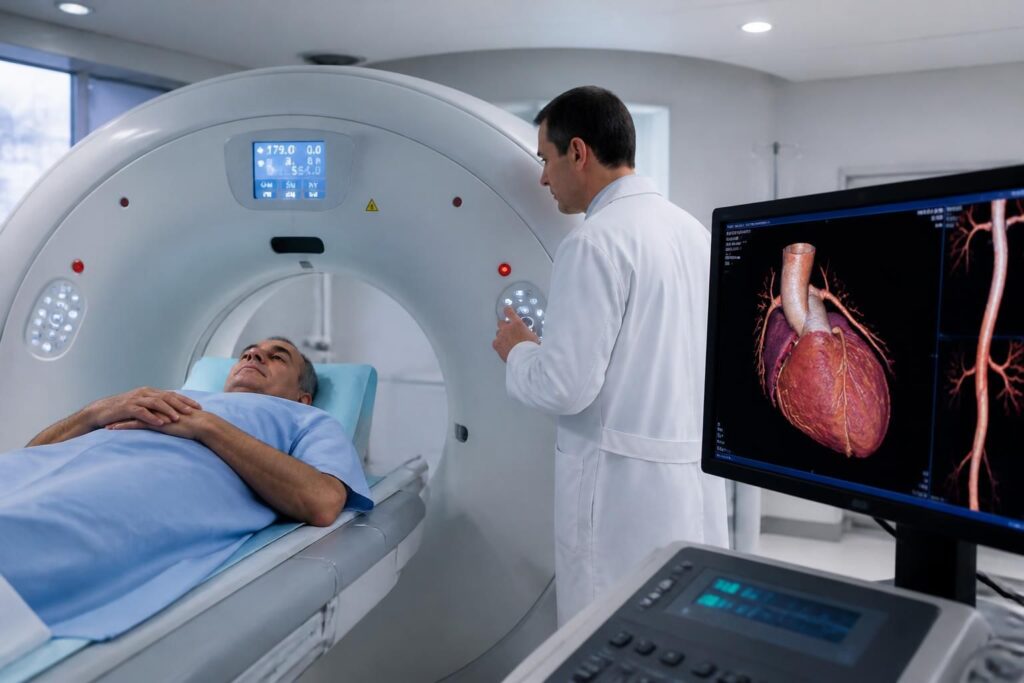
The angioscan is established as a major breakthrough in medical imaging, profoundly transforming cardiovascular diagnosis. This non-invasive, rapid, and precise examination offers detailed visualization of the coronary arteries and blood vessels, allowing for the fine identification of atheromatous plaques, aneurysms, pulmonary embolisms, or stenoses. In 2026, faced with the increasing prevalence of cardiovascular diseases, this technology revolutionizes cardiac prevention and optimizes therapeutic strategies, bringing new hope in the fight against these diseases that are often silent but potentially deadly.
The article in brief
The angioscan revolutionizes cardiovascular care through precise and rapid diagnosis by non-invasive medical imaging.
- Detailed visualization of coronary arteries: Precise diagnosis of atheromatous plaques and stenoses.
- Speed and simplicity of the examination: Results available in less than 15 minutes.
- Broad and versatile diagnosis: Pulmonary embolisms, aneurysms, thromboses effectively detected.
- Optimized cardiac prevention: Personalized monitoring and facilitated surgical planning.
An essential tool that changes the game in the detection and management of cardiovascular diseases.
Angioscan: a medical imaging technology serving cardiovascular diagnosis
The angioscan combines X-rays and an injection of an iodized contrast agent to offer an accurate and three-dimensional representation of the blood vessels. This non-invasive method allows detailed examination of the coronary arteries, the heart, and other essential vascular territories. In a few minutes, it highlights anomalies often invisible to other examinations, a decisive advantage for detecting atheromatous plaque, the primary cause of cardiovascular disease.
The strength of this technique lies in its ability to provide rapid diagnosis in hospital or outpatient settings, avoiding more invasive exploratory interventions. It is a valuable ally for physicians facing atypical cardiac symptoms or in the context of personalized prevention.
When and why perform a cardiac angioscan?
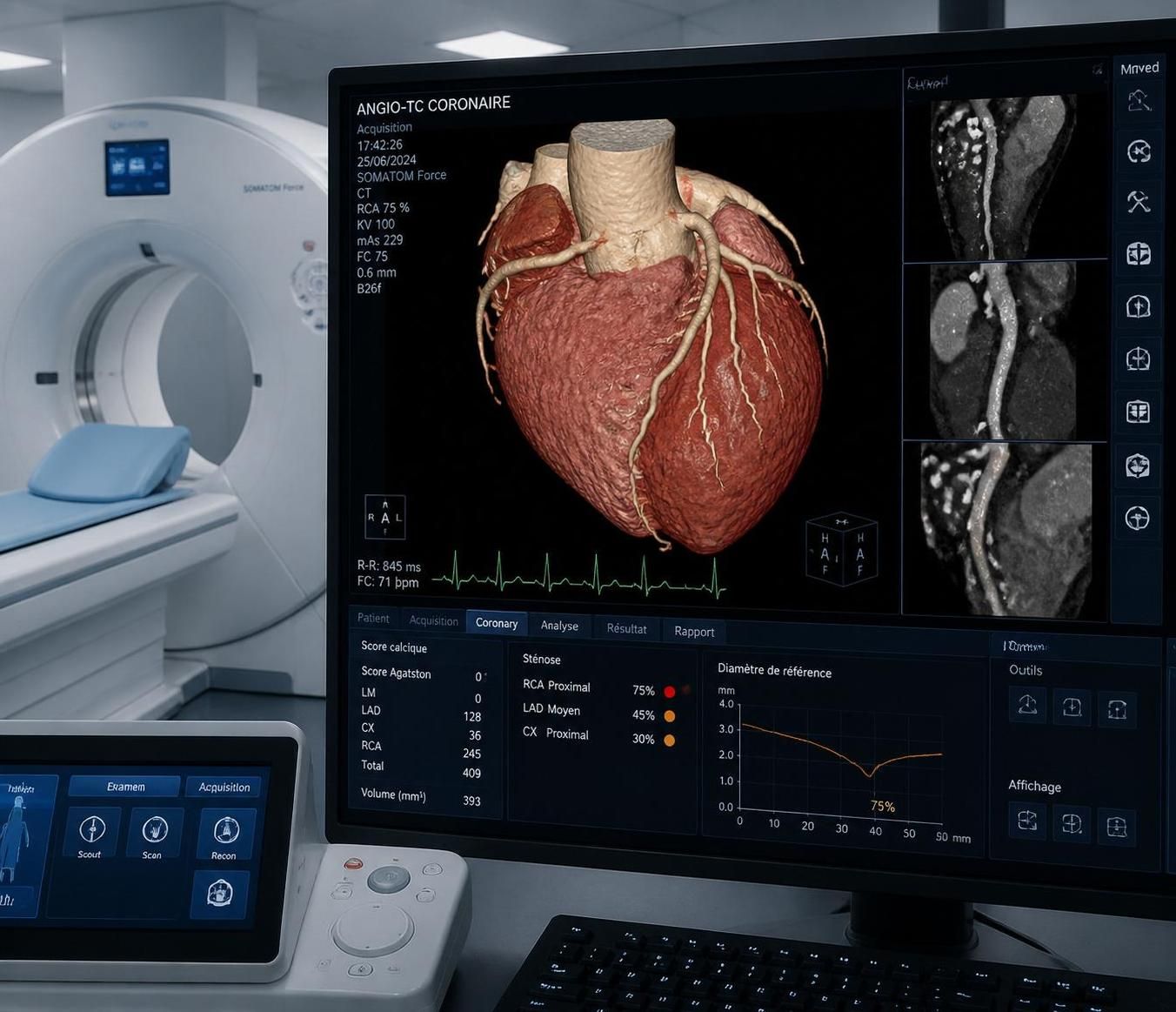
The use of the angioscan is particularly recommended in several critical situations. In case of sudden chest pain, this examination allows for the rapid exclusion of a heart attack or the identification of a pulmonary embolism, a medical emergency. It is also essential for monitoring patients suffering from aneurysm or arterial stenosis, detecting narrowing or dilations threatening blood flow.
Also valued for preoperative vascular mapping, the angioscan effectively guides surgical planning and complex radiological interventions. For example, in high-risk patients – smokers, hypertensives, diabetics – it allows precise visualization of the atheromatous plaque, thereby promoting better-targeted cardiac prevention.
Major advantages of the angioscan in cardiovascular diagnosis
- Surgical precision: Detailed 2D and 3D images for fine evaluation of vascular lesions.
- Non-invasive examination: No incision or prolonged hospitalization, a simplicity appreciated by patients.
- Speed of results: Results often available the same day, accelerating treatment.
- Versatility: Diagnosis of embolisms, aneurysms, thromboses, vascular malformations.
- Relative safety: Systematic control of contraindications and particular vigilance in cases of renal failure or allergy to contrast agent.
Targeted cardiovascular diagnosis: comparative table of angioscan indications
| Main indication | Concrete example | Added value | Indicative cost (France) |
|---|---|---|---|
| Pulmonary embolism | Chest pain with shortness of breath | Precise visualization of the clot | 100–180 € |
| Aortic aneurysm | Sudden abdominal pain | Exact measurement and localization | 120–220 € |
| Carotid stenosis | Stroke prevention in at-risk patients | Detailed mapping of narrowings | 110–180 € |
| Deep vein thrombosis | Unexplained swollen leg | Exploration of the entire venous network | 100–180 € |
| Preoperative vascular assessment | Heart surgery, transplant | Detailed 3D analysis | 130–240 € |
Procedure and patient experience: what to expect during an angioscan?
The angioscan is performed quickly, painlessly, with appropriate support. After a medical check, a small intravenous line is placed to inject the contrast agent. The patient is then asked to remain still for a few seconds, while the scanner captures precise images. A sensation of warmth is common at the injection, but it quickly disappears. The simplicity of this procedure contrasts with the importance of the information obtained, essential for targeted and effective medical care.
Limits and special precautions to know
While the angioscan is powerful, certain precautions must be respected. It is contraindicated in cases of severe renal failure, pregnancy, and known allergies to the iodized contrast agent. A prior assessment is systematically performed to minimize risks. Vigilance remains essential, particularly to limit exposure to X-rays, by adjusting the frequency of examinations according to needs.
A technological revolution for cardiac prevention in 2026
Thanks to constant advances in equipment, the angioscan now provides ever more precise images with a reduced radiation dose. This technological revolution improves the early detection of atheromatous plaques and other cardiovascular risk factors. The gain? A faster diagnosis and a more individualized therapeutic journey, which in 2026 helps save thousands of lives upstream, before complications occur.
What is an angioscan?
It is a non-invasive medical imaging examination using X-rays and an iodized contrast agent to precisely visualize blood vessels.
In which cases is an angioscan prescribed?
It is prescribed in cases of suspected pulmonary embolism, aneurysm, stenosis, thrombosis, or for surgical preparation.
Is the examination painful?
No, the angioscan is painless. Only a brief sensation of warmth during the injection may occur.
What are the major contraindications?
Severe renal failure, allergies to the iodized contrast agent, and pregnancy are important contraindications.
How much does an angioscan cost?
The cost varies depending on the indication between €100 and €240, largely reimbursed by Social Security in France.


