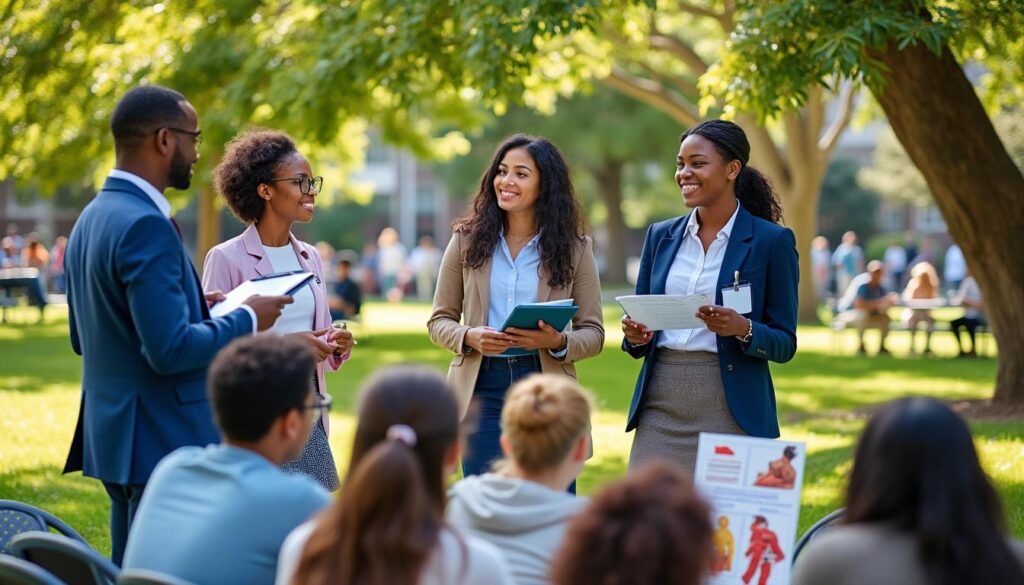
In a constantly evolving healthcare landscape, peer health educators emerge as essential players in community health prevention and education. Their mission goes beyond simply conveying information: they create a bond based on trust and shared experience, encouraging the emergence of healthier behaviors. Relying on specific skills and innovative approaches, they actively contribute to reducing inequalities and strengthening collective well-being.
🕒 Article in brief
Dive into a participatory approach where peers and communities mobilize for accessible and effective health prevention.
- ✅ Origins and specifics of peer educators: An innovative approach rooted in participatory prevention
- ✅ Targeted training and key skills: Relational know-how and knowledge in health promotion
- ✅ Evaluated impact: Quantitative and qualitative measures confirming the effectiveness of interventions
- ✅ Integration and perspectives: Toward official recognition and sustainable networks
📌 By combining lived experience and social proximity, the peer health educator renews health education for more inclusive and sustainable prevention.
The origins and definition of the peer health educator in community health
The very notion of “peer health educator” is anchored in the ability to share an experience and a common belonging with a given group. This sharing facilitates a more natural exchange, as it is based on cultural, social, or generational proximity, often absent from traditional institutional approaches. Since the 2000s, this concept has grown in importance, integrating a triple dimension carried by public health policies: prevention, health education, and health promotion.
Historically, Inpes (National Institute for Prevention and Health Education) and the French Society of Public Health have led studies demonstrating the effectiveness of peer education in reducing risky behaviors, especially among adolescents. These experiences have shown that a prevention message delivered by a peer, recognized and respected, reaches audiences who are distant from traditional systems more effectively.
The theoretical framework is based on the idea that health is not limited to disease management but includes the development of individual skills to better cope with social, cultural, and environmental determinants.
Differentiating peer educators from other health professionals
Unlike traditional medical professionals, peer health educators do not position themselves as expert authorities but as communication facilitators. They do not necessarily have extensive medical training but undergo specific training, often brief, focused on listening and facilitation. Their role is complementary; it takes place within a more equal and empathetic dialogue, using simple and accessible language.
| Criterion | Peer health educator | Health professional |
|---|---|---|
| Social origin | Same cultural or social group 👥 | Healthcare education 🩺 |
| Position | Facilitator, peer supporter 🤝 | Authority, prescriber 📋 |
| Training | Short modular training 🎓 | Long medical training 🩻 |
| Area of action | Community and peer groups 🌍 | Clinical settings 🏥 |
For example, a pilot program in Lyon showed that a peer health educator facilitating a workshop on stress management in schools enabled a more open dialogue: students expressed their difficulties better, thus breaking isolation and improving their ability to seek help.
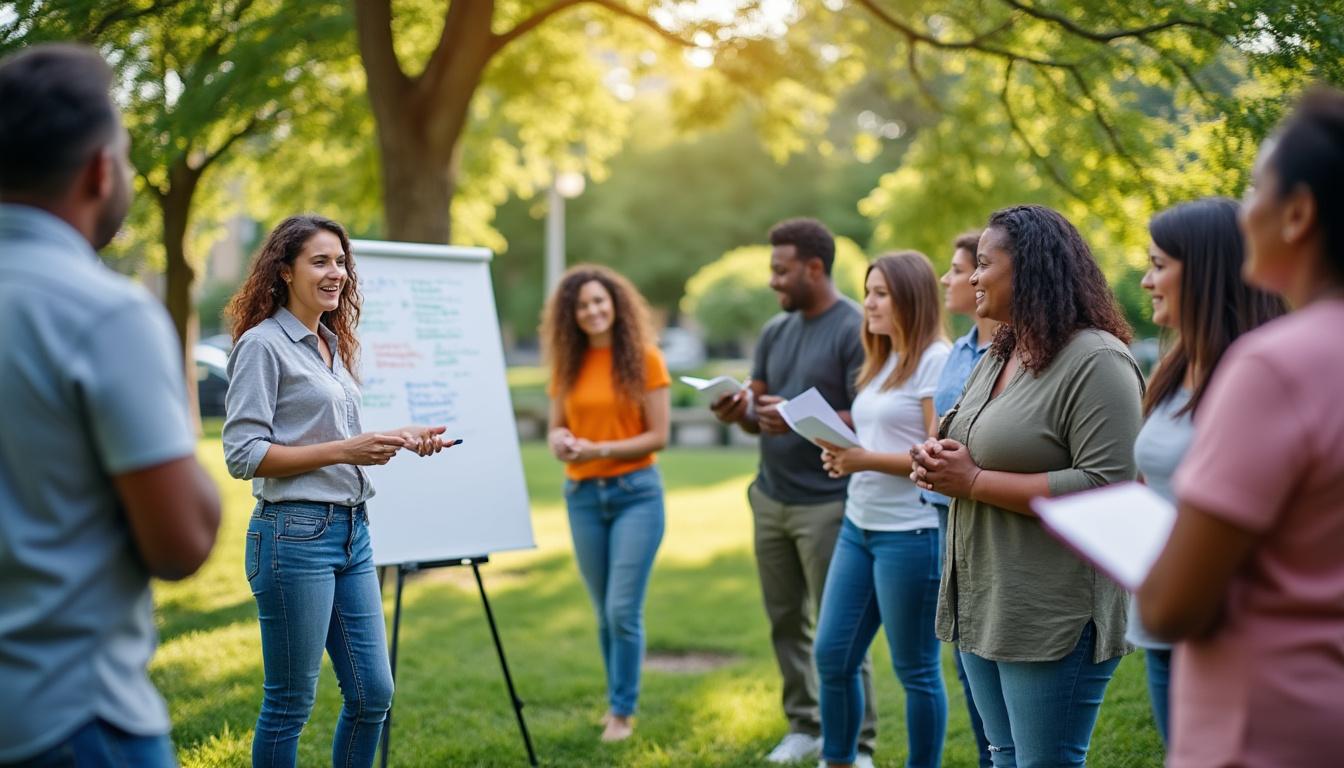
Essential training and skills of peer health educators
The quality and effectiveness of peer health educators largely depend on their training, which must be both solid and adapted to their specific missions. Numerous modular trainings, ranging from 20 to 60 hours, have been designed to balance technical knowledge and interpersonal skills, with communication playing a central role.
Key modules for successful training
- 🎧 Active listening and communication techniques: Knowing how to capture the implicit needs of the audience through adapted interviewing techniques.
- 🏥 Prevention knowledge: Understanding essential public health concepts, notably vaccination, hygiene, and screening.
- 🌐 Identification of social determinants: Grasping the impact of environment, inequalities, and cultural factors on health.
- 👥 Group animation and participatory workshops: Encouraging participation and creating a friendly and safe space for exchange.
- 📊 Action evaluation: Mastering tools to measure the impact of interventions, analyze results, and adjust actions.
Beyond technical knowledge, certain human qualities are essential to practice this profession:
- 💖 Empathy: Creating a climate of trust and safety.
- 🔄 Adaptability: Adjusting communication to each profile.
- 🤝 Teamwork: Collaborating with professionals and other peers to strengthen impact.
- 📋 Methodological rigor: Documenting actions in accordance with established standards.
- 🎨 Creativity: Offering innovative intervention modes: videos, social networks, podcasts.
A concrete example to know: in a Lyon neighborhood, a peer health educator organized a series of workshops on smoking cessation awareness following a high prevalence of smokers. In one year, participation in specialized consultations increased by 40%, demonstrating the effectiveness of training focused on lived experience and direct communication.
Measuring the concrete impact of peer health educators in health prevention
Evaluating peer educator interventions requires a rigorous approach combining quantitative and qualitative data. This evaluation is essential to justify program sustainability and continuous improvement.
Key indicators to monitor
| Indicator 📈 | Measurement method 🛠️ | Objective |
|---|---|---|
| Participation | Reports and attendance tracking 📋 | Measure adherence to the initiative |
| Knowledge acquired | Pre- and post-intervention questionnaires 📝 | Assess knowledge progression |
| Behavior changes | Qualitative interviews and self-reports 💬 | Observe impact on daily practices |
| Hospitalization reduction | Medical data analysis 🔍 | Quantify clinical benefits |
A study conducted in 2024 among obese patients followed by peer health educators revealed an average weight loss of 5% in six months, compared to only 2% in a non-followed group. Moreover, participants showed better knowledge of diabetes and hypertension prevention strategies.
This clearly illustrates how the peer approach strengthens engagement and encourages lasting changes, where institutional messages do not always succeed in mobilizing the audience.
Quiz: Becoming a peer health educator
Find out if you know the role and missions of a peer health educator through this fun and educational questionnaire.
Integration modes and collaborations of peer health educators within the health system
The gradual integration of peer health educators into health establishments and structures represents a major development in recent years. Associated with multidisciplinary teams, they play a key role in therapeutic education and health promotion.
Examples of structures hosting peer educators
| Type of structure 🏢 | Main role of the peer health educator 🧑🏫 | Key partner 🤝 |
|---|---|---|
| Screening center | Reception, orientation, and information | ANESM |
| Multidisciplinary health center | Post-hospitalization follow-up and chronic management | Health Insurance |
| Schools and educational institutions | Awareness and prevention workshops | Ministry of Education / Inpes |
| Neighborhood associations | Community activities and social support | Secours Populaire Français |
This collaboration offers many benefits, among which the strengthening of trust between users and health professionals, reducing caregivers’ workload, and better appropriation of prevention messages. For example, in some Parisian hospitals, the presence of peer educators increased patient satisfaction by 20% thanks to a more human and personalized welcome.
Current challenges and future prospects for peer health educators
At the dawn of 2026, educational peer health educators face several challenges to consolidate their place within the public health system. The lack of official recognition and uncertain funding are major obstacles. Developing a national skills reference framework and creating sustainable statuses are crucial steps to ensure the longevity of their mission.
- 💼 Professional status: Promote a recognized framework with stable contracts.
- 🌍 Diversity: Recruit peers from all sociocultural backgrounds.
- 📱 Digital innovation: Use digital tools without losing the human touch.
- ⌛ Long-term evaluation: Measure public health impacts over an extended period.
Public and associative actors are also working towards better articulation between peers and professionals, encouraging co-construction of programs. The emergence of European networks and continuing education promise a sustainable future for these health mediators.
An encouraging example comes from the launch of a digital platform in 2025, facilitating experience exchanges between peer educators in rural and urban areas. This innovation connects thousands of actors and allows sharing of practices adapted to local contexts.
What is a peer health educator?
A peer health educator is a person from the same community as their audience and trained to deliver health messages through shared experience and facilitation.
What training is required?
Modules of 20 to 60 hours, offered by specialized organizations such as Inpes, EducAction, and the French Red Cross.
How to evaluate the effectiveness of their actions?
Thanks to quantitative indicators (participation rates, questionnaires) and qualitative indicators (interviews, feedback from beneficiaries).
Where do they operate?
Mainly in schools, screening centers, health centers, local associations, and sometimes hospitals.
What is the future for these educators?
Professionalization, official recognition, and sustainable funding will strengthen their role in prevention by 2030.


