
A heart that skips a beat at rest, a sharp sensation in the chest, then everything returns to normal: the extrasystole at rest can be surprising. In most cases, these irregular beats remain benign, but their repetition, intensity, or context can turn a simple discomfort into a real cardiac alarm. Knowing how to recognize cardiac symptoms, understanding what triggers them, and identifying the signals that require consultation helps protect cardiovascular health without giving in to panic.
The article in brief
Extrasystoles at rest are common, often reassuring, but sometimes indicative of a more serious cardiac rhythm disorder. The challenge is to distinguish isolated palpitations from situations that require prompt medical advice.
- Usually benign premature beats: they frequently occur in healthy adults
- Symptoms to recognize: palpitations, perceived pause, chest discomfort, dizziness
- Useful examinations to decide: ECG, Holter, ultrasound depending on the clinical context
- Alarm signals not to ignore: chest pain, fainting, shortness of breath, loss of consciousness
Properly interpreted, extrasystoles are often managed with more calmness than one might imagine.
In practice, many people discover these extrasystoles during a moment of calm, at bedtime or while sitting still reading on the couch. The heart then seems to “slip” for a fraction of a second, like a musician playing a note too early in a well-rehearsed orchestra. This sensation, very striking at the moment, does not automatically mean danger. However, when palpitations become more frequent, are accompanied by shortness of breath, or disrupt daily life, listening to the body deserves to be taken seriously.
In France, rhythm disorders of this type are far from rare: they affect a large portion of adults, often without major consequence. The most tricky part is that personal perception varies greatly from one person to another. Some hardly feel anything, others describe a clear jolt, a “gap” in the cardiac rhythm, or even a feeling of pause. It is precisely this variability that explains why a teleconsultation can help guide, but does not always replace an in-person examination when a cardiologist must listen to the heart and record an ECG.
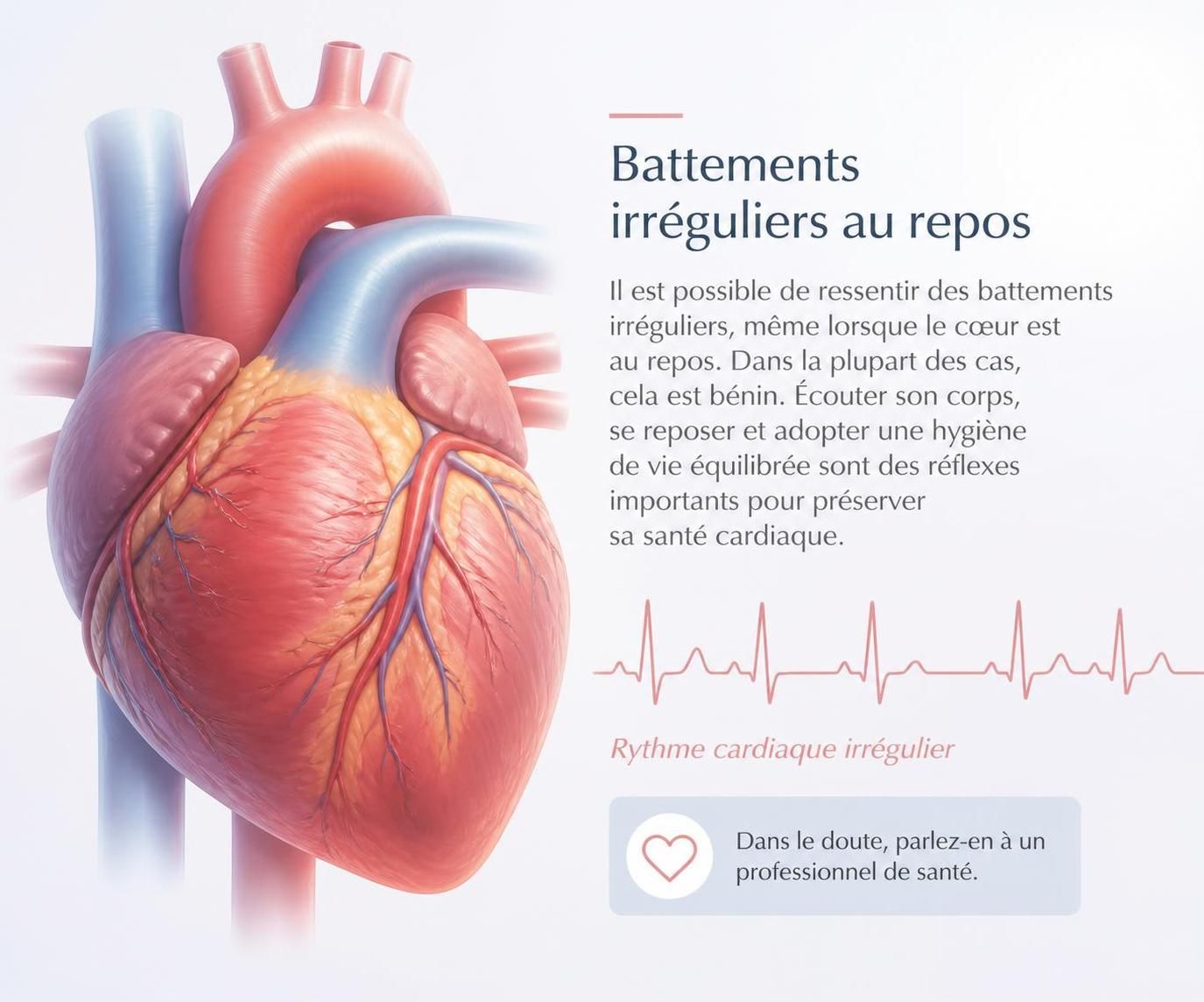
Extrasystole at rest: what this premature beat really reveals
An extrasystole corresponds to a cardiac contraction that occurs earlier than expected in the usual cycle. The heart is not “broken” for all that: it simply sends an electrical signal in advance, which creates this impression of a missed beat or a small jab in the chest. Two main types exist, depending on whether the impulse originates in the atria or the ventricles, and this distinction helps the doctor interpret the tracing. In most cases, the arrhythmia remains isolated and does not indicate anything serious.
A concrete example: a busy 42-year-old active woman, very engaged in her work, mainly feels her irregular beats in the evening, after a tense day and one coffee too many. After evaluation, no structural problem is found. Conversely, in a person who also presents chest pain, unusual fatigue, or cardiac history, the same sensation should not be minimized. The context makes all the difference, like in a score: a note played early does not have the same meaning depending on the rest of the ensemble.
To delve deeper into the factors most often raised in consultation, a useful insight is offered in this article on the common causes of extrasystoles. It helps connect symptoms to very everyday triggers, from stress to fatigue to stimulants. This reading nicely complements a medical approach, as identifying the cause often allows for a more stable rhythm to be regained.
Cardiac symptoms: when the sensation becomes a signal to listen to
The most typical sign remains the perception of a “too many” beat or a missing beat, followed by a stronger contraction. Some people talk about a jab in the chest, others about a flutter, a heart that restarts late. This sensation can be unique or repeated, brief or very disturbing. It is not necessarily proportional to the severity of the disorder, which explains why one person can be very bothered while another barely notices.
Associated cardiac symptoms deserve special attention: dizziness, tightness, sudden fatigue, malaise, unusual shortness of breath. In some patients, anxiety then settles in and maintains the phenomenon, creating a vicious circle. The body races, the mind worries, then stress can increase palpitations. This is a very common mechanism, especially at rest when everything becomes more audible in silence.
A nurse in teleconsultation can already collect a precise description: frequency, duration, triggering factor, history, medications, caffeine or alcohol consumption. But as soon as an episode becomes prolonged, poorly tolerated or associated with malaise, it is necessary to move beyond remote observation. The clinical picture must then be confirmed by a face-to-face examination, as vigilance always takes precedence over convenience.
Causes of irregular beats at rest and factors that promote them
Extrasystoles sometimes appear without a clear cause, but several triggers often recur. Stress, fatigue, caffeine, alcohol, tobacco or certain stimulant medications can make the heart’s electrical system more irritable. Imbalances in potassium or magnesium also play a role, as do certain already known cardiac diseases. In short, the heart can react to a fragile terrain, a bit like an instrument very sensitive to the temperature of a room.
In health consultations, it is not rare for a person to notice a worsening during a period of mental overload. A professional deadline, disturbed sleep, several coffees a day, then the surprise of feeling irregular beats at rest: the scene is classic. This does not mean everything is “in the head”. It means rather that the body and stress often work hand in hand, especially when recovery is insufficient.
In athletes or very active people, the phenomenon also deserves careful consideration. Intense exertion may reveal a particular sensitivity of the cardiac rhythm, and certain episodes justify a specialized evaluation. The objective is not to scare, but to distinguish what relates to a functional reaction from what signals a pathology to monitor.
The most common triggers to identify
- Stimulants: coffee, energy drinks, nicotine, alcohol
- Nervous terrain: stress, anxiety, lack of sleep
- Biological causes: lack of magnesium, potassium or thyroid disorder
- Cardiac context: heart disease, rhythm history, hypertension
This list does not replace a diagnosis, but it helps put a bit of order in the investigation. Often, identifying a single trigger already significantly reduces the frequency of episodes.
Useful examinations to confirm an extrasystole and assess risk
The diagnosis initially relies on listening to the patient’s story. Then comes the ECG, the reference examination, simple and painless, but which can miss an intermittent episode. That is why a Holter over 24 to 48 hours, sometimes more, is often proposed to record the cardiac rhythm in real life. Cardiac ultrasound then completes the assessment when it is necessary to check the heart’s structure.
The table below summarizes the usual logic of the assessment. It clearly shows that not all cases are alike: a young person without history and little discomfort does not have the same journey as a patient with known heart disease. In cardiology, nuance counts as much as technology.
| Examination | What it provides | When it becomes important |
|---|---|---|
| ECG | Captures electrical activity and confirms arrhythmia | During first evaluation |
| Holter ECG | Measures the actual frequency of extrasystoles over time | If episodes are intermittent or repeated |
| Cardiac ultrasound | Checks heart structure and function | If a cardiac terrain is suspected |
| Biological assessment | Looks for imbalance in minerals or other causes | In case of doubt about clinical context |
An in-person consultation remains essential when a complete clinical exam is necessary. Teleconsultation helps sort, but does not replace either auscultation or electrical recording of the heart. This point is crucial, especially if palpitations are new, very close together or poorly tolerated.
When irregular beats should alert immediately
Most extrasystoles do not pose an immediate threat. However, some signs should be considered as a real cardiac alarm. Intense chest pain, malaise with loss of consciousness, major shortness of breath at rest or very rapid and prolonged palpitations completely change the interpretation of the situation. In this case, call 911 or emergency number immediately, without waiting to see if “it passes”.
The reasoning is simple: an isolated symptom can be harmless, but several associated signs sometimes indicate a more serious condition. A patient who describes both irregular beats and a feeling of imminent death should never be left alone with their worry. Better a reassuring evaluation than delayed care. This rule especially protects people already having cardiovascular disease or a heavy family history.
People often talk about a frequency threshold, but the impact matters just as much. Very frequent extrasystoles, occurring several times per minute or almost continuously, warrant quick advice. When the heart disrupts sleep, walking, or the slightest effort, the signal should no longer be classified among minor daily anomalies.
Situations that justify urgent advice
- Severe chest pain: especially if it accompanies palpitations
- Malaise or syncope: feeling of fainting or loss of consciousness
- Marked shortness of breath: at rest or with minimal effort
- Sustained palpitations: very rapid rhythm with great anxiety
Caution is not dramatization. Faced with the heart, it often remains the best ally.
Treatments and daily actions to better live with these cardiac symptoms
When extrasystoles are benign, the first “treatment” often consists of reducing the factors that sustain them. Sleeping more, reducing caffeine, moderating alcohol, quitting tobacco, and learning to release pressure can already make a big difference. Slow breathing approaches, regular walking, yoga or cardiac coherence find their full place here. These are simple but powerful tools, as the experience of little daily gestures passed on from generation to generation has often reminded.
If symptoms persist or become troublesome, a doctor may propose a beta-blocker or, more rarely, another treatment adapted to the situation. In certain frequent or resistant forms, catheter ablation becomes a targeted option, performed in a specialized environment. Here again, the idea is not to multiply interventions, but to choose the right response at the right time.
To keep a clear view, an episode diary helps a lot. Noting the time, context, meal, stress, sleep quality, and drinks consumed often allows to highlight a discreet trigger. This simple follow-up also gives the cardiologist a concrete basis to adapt care.
Some useful habits stand out clearly:
- reducing stimulants when the heart becomes sensitive
- splitting meals if episodes occur after large meals
- drinking regularly without excess
- preserving stable sleep
- consulting if cardiac symptoms intensify or change
As balance returns, many patients rediscover more peaceful rest and a less “noisy” heart.
Teleconsultation and extrasystoles: useful but not always sufficient
Teleconsultation already allows progress: it helps describe palpitations, identify triggers, and evaluate the impact on daily life. It is therefore valuable when episodes are occasional and no sign of severity appears. On the other hand, as soon as it is necessary to listen to the heart, confirm an arrhythmia or decide on complementary tests, the physical encounter remains the reference.
The good practice consists of preparing some elements before the exchange: duration of episodes, ongoing treatments, history, already performed exams, caffeine or alcohol consumption. This simple observation work greatly facilitates clinical sorting. And above all, it prevents trivializing a situation that may deserve a quick ECG.
Teleconsultation should therefore be seen as a doorway, not an absolute shield. In case of doubt about severity, calling emergency services remains a priority.
Is an extrasystole at rest necessarily serious?
No, most extrasystoles at rest are benign, especially on a healthy heart. They become concerning if they are very frequent, poorly tolerated, or associated with other cardiac symptoms.
Which signs require quick consultation?
Chest pain, significant shortness of breath, malaise, loss of consciousness, or very rapid palpitations require medical advice without delay.
Which examinations confirm an extrasystole?
The ECG, Holter ECG, and sometimes cardiac ultrasound help confirm the cardiac rhythm disorder and check that no underlying cause is present.
Can extrasystoles be reduced with lifestyle habits?
Yes, reducing caffeine, sleeping better, managing stress, and limiting tobacco or alcohol often help reduce episodes, especially when they are triggered by daily life.
Is teleconsultation sufficient for a first opinion?
It can guide the evaluation, but does not always replace an in-person exam, especially if an ECG or auscultation is necessary to specify the diagnosis.


